Georgia Organics hosts a series of educational workshops, Organic Growers Farmer Field Days (OGFFDs), as part of the Farmer Services GO Organic! program to provide a portfolio of services geared specifically towards transitioning and Certified Organic farmers.
WHO'S GROWING OUR SEEDS: Berry Family Farms is Nurturing Wisdom for Future Generations
EXPANDING HORIZONS: Farmer Champion Program Ventures into Higher Education in 2024
We're thrilled to share that in 2024, our Farmer Champion program is expanding to colleges and universities.
FARMER FIELD DAY RECAP: Small Engine Repair Workshop at Bread and Butter Farms
This Farmer Field Day, attendees gathered at Bread and Butter Farms in Sparta, GA, to learn about diagnosing engine problems and indulge in some southern style farm-fresh eats at Harvest Kitchen and Market.
FARMER FIELD DAY RECAP: Business Development & On Farm Solar Solutions at Berry Family Farms
Representatives of 15 farms from Southeast Georgia attended this farmer field day, hosted at Berry Family Farms in Ludiwici, GA.
WE ARE PEPPER TOGETHER! Highlights from this year’s October Farm to School Month Campaign
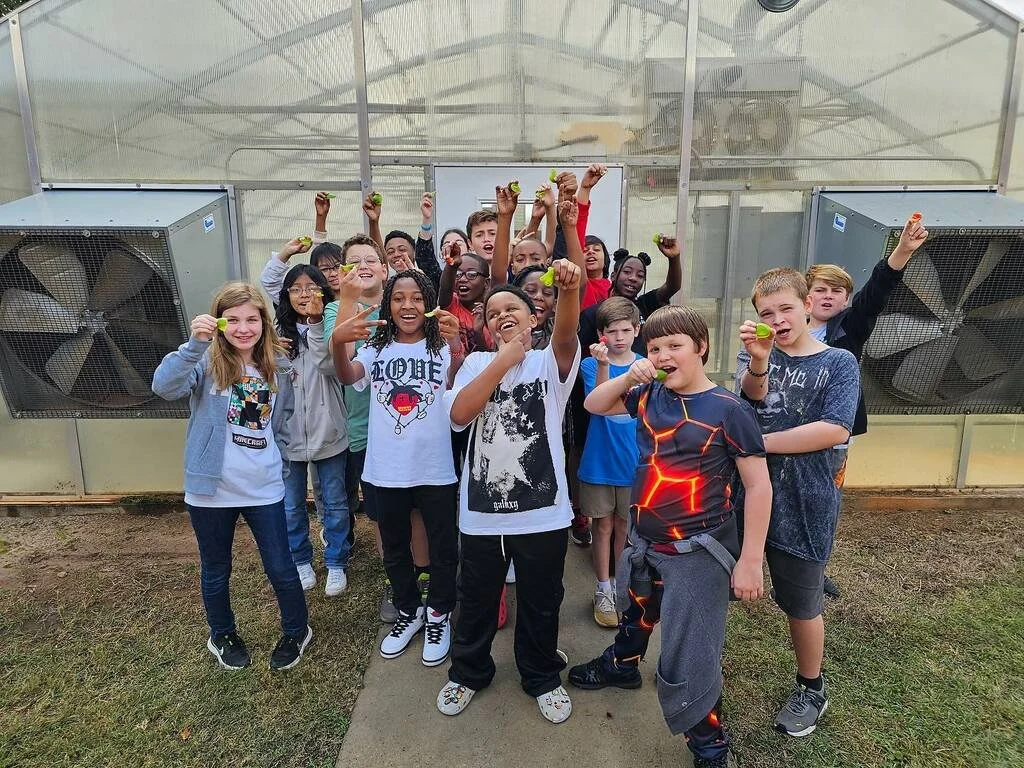
Pepper Palooza was a state-wide campaign to get kids eating, growing, and participating in pepper-themed activities, and because of your participation and support, it did!
GUEST BLOG: Caring Collaborations in Ag-Education with Community Sprouts & Friends
By Michelle Gambon
Michelle Gambon is an educator, the Founder of Community Sprouts, and the Owner of Go Grow Enviro.
GEORGIA ORGANICS’ APPRENTICESHIP PROGRAM: 2023 AND BEYOND
GEORGIA ORGANIC'S PEPPER PALOOZA CAMPAIGN RECAP: Farm to School Made Easy for Teachers
ORGANIC GROWERS FARMER FIELD DAY RECAP: Raising Profits & Organic Livestock
At Grateful Pastures Farm — the only Certified Organic poultry farm in Georgia — field day attendees took an autumnal farm tour while learning about pasture management and, later, the importance of record keeping.
Highlighting our 2023 Farmer Champion Award Winners
Georgia Organics’ Farmer Advocacy News: Georgia Farmers Inform Our 2023 Farm Bill Priorities
By Michael Wall
Michael Wall is Georgia Organics’ Director of Advocacy and previous Director of Farmer Services.
In 2021, the Georgia Organics board of directors passed a Strategic Plan that put the organization on a new path for advocacy, farm policy, and movement building. A new division of Georgia Organics, Farmer Advocacy, was launched in January 2022.
To better understand the policy priorities of our farmers, Georgia Organics Farmer Advocacy, with input from Listen4Good and the Georgia Organics Advocacy and Programs Committee, launched a survey initiative. Over the spring and early summer of 2022, Georgia Organics distributed a survey to more than 1,000 farmers to determine their highest policy priorities.
The results of that survey, featuring the input from 128 organic and sustainable farmers, are below. The survey data has also been published as a report (available here) that has been shared with dozens of advocacy partners and Congressional lawmakers.
Demographic data on the farmers who filled out the survey is also provided at the conclusion of the survey’s results summary below.
(Note: Funding to support the facilitation of this report was received from The National Sustainable Agriculture Coalition. Georgia Organics’ Farmer Advocacy efforts have also received funding from Organic Valley and Farm Aid.)
Rep. Austin Scott, vice chair of the U.S. House Committee on Agriculture, second from left, with farmer Russell Brydson of Narrow Way Farms, Director of Farmer Advocacy Michael Wall, and Legislative Director Zach Roberts.
Survey Question: Which government functions are most important for your farm’s success?
The majority of survey participants cited USDA programming on conservation as most important to their farm’s success.
The following statistics reflect the total survey participant responses, ranked by highest to lowest percentages:
USDA Programming on conservation, such as the National Resource Conservation Service (NRCS); 58.6%
USDA Programming on crop insurance and access to capital, such as the Farm Service Agency (FSA); 40.23%
Local zoning code and ordinances and code enforcement; 29.89%
State regulations and enforcement; 21.84%
State licensing; 18.39%
National Organic Program (NOP) standards and enforcement; 12.64%
Local licensing; 10.34%
National Organic Program (NOP) organic transitioning support; 8.05%
Survey Question: Which institutions are most important for your farm’s success? Please select the two most important to your farm.
The majority of survey participants cited USDA offices and Land Grant universities as the two institutions most important to their farm’s success.
The following statistics reflect the total survey participant responses, ranked by highest to lowest percentages:
USDA offices, such as FSA, NRCS; 49.43%
Land Grant universities, because of their research, education, and extension offices; 44.83%
Other farmer services organizations, such as the Southeastern African-American Farmers Organic Network (SAAFON), Global Growers, Food Well Alliance, Southwest Georgia Project, etc.; 36.78%
Advocacy groups that address issues such as climate change, soil health, and racial equity; 35.63%
The Georgia Department of Agriculture (GDA); 33.33%
Survey Question: Which of the following issues are most important for your farm’s success?
The majority of survey participants cited healthy soil and access to capital and USDA programs as issues most important to their farm’s success, followed by a tie between conservation programs and land-ownership.
The following statistics reflect the total survey participant responses, ranked by highest to lowest percentages:
Healthy soil; 52.87%
Accessing USDA programs; 42.53%
Access to capital; 32.18%
Climate change; 29.89%
(tie) Conservation programs: access and cost share amounts; 28.74%
(tie) Land-ownership; 28.74%
Health insurance costs and access; 25.29%
Racial equity; 18.39%
Building a statewide sustainable ag policy coalition; 13.79%
Succession planning; 8.05%
Access to land zoned for agriculture; 6.9%
Crop insurance and subsidies; 5.75%
Heirs property issues; 4.6%
POLICY IMPLICATIONS: What We Gathered from Listening to Georgia Farmers
Based on the feedback provided by our farmers, Georgia Organics recommends the following policy shifts:
Increase funding and access to the Farm Bill’s Title II: Conservation section.
Double the cost-share rates for all soil health-related conservation activities and contracts available in the National Resource Conservation Service’s (NRCS) Environmental Quality Improvement Program (EQIP) and Conservation Stewardship Program (CSP).
Invest more deeply in organic research, including the SARE (Sustainable Agriculture Research and Education) program.
Provide training and outreach for Approved Insurance Providers (AIPs) to ensure equitable access to RMA’s crop insurance programs for small-scale and organic producers.
Ensure organic integrity and a strong organic marketplace by continuously improving the National Organic Program (NOP).
Increase and consolidate the Farm Service Agency’s (FSA) organic cost-share reimbursements from two applications capped at $750 to one application capped at $1,500 per farm per year.
Make the recently announced Organic Transition Initiative (OTI) a permanent program.
Allow the Beginning Farmer and Rancher Development Program (BFRDP) grant funds to be spent on infrastructure needs, such as seeds, inputs, implements, irrigation, harvest bins, and washing stations.
Demographics of Survey Participants
The following statistics reflect the total survey participant responses, ranked by highest to lowest percentages:
Relationship to Farming
The majority of survey participants identified as farm owners. There was a small tie between those identifying as aspiring farmers and farmer support providers.
Farm owner – 77.91%
Farm Manager - 22.09%
Farm Worker – 17.44%
Community organizer – 13.95%
Other – 9.3%
Agricultural educator – 6.98%
Aspire to own farmland – 5.81%
Agricultural researcher – 3.49%
Don’t farm but aspire to (tie) – 2.33%
Farmer support service (tie) – 2.33%
Ag student – 1.16%
Farm and Production Type
The majority of survey participants claimed their main production to be diversified vegetable crops, along with fruits and eggs.
Diversified veg - 78.67%
Fruits – 46.67%
Eggs – 34.67%
Mushrooms – 20%
Goats or other small ruminants for meat – 10.67%
Beef cattle (tie) – 8%
Commodities (tie) – 8%
Chicken for meat – 5.33%
Hogs for meat – 4%
Grains (tie) – 2.67%
Goat milk (tie) – 2.67%
Row crops for livestock feed (tie) – 2.67%
Acreage
The majority of survey participants claimed to farm on somewhere between less than an acre and 20 acres.
<1 acre – 19.05%
1 to 3 – 17.86%
4 to 10 – 17.86%
10 to 20 – 14.29%
30 to 50 – 9.52%
50 to 100 – 7.14%
100 to 300 – 7.14%
300 to 500 – 2.38%
500 to 1,000 – 3.57%
1,000 to 2,000 – 1.19%
Age
The majority of survey participants identified as ages 35 to 64.
35-44 years – 38.55%
45-54 – 20.48%
55-64 – 15.66%
65-74 – 14.46%%
25-34 – 7.23%
17 or younger – 2.41%
75 or older – 1.20%
18-24 – none
Racial Identity
The majority of survey participants identified as white.
White – 65.85%
Black or African American – 25.61% *
Asian or Asian American – 6.10%
Native American or Alaska Native – 6.10%
Hispanic or Latino/a/x – 4.88%
Middle Eastern or North African – 1.22%
*In the U.S., Black farmers make up 1.4 percent of the farming community, and in Georgia, 4 percent, according to the USDA Census of Agriculture.
Gender
The majority of survey participants identified as men.
Man – 57.5%
Woman – 41.25%
Non-Binary – 1.25%
Future Farmer Engagement
The majority of survey participants claimed they were in favor of supporting an advocacy committee and were willing to meet with Georgia-elected officials.
Are willing to support an advocacy committee – 40 farmers
Are willing to meet with state-level elected officials – 38 farmers
Are willing to meet with USDA/GDA officials – 35 farmers
Are willing to meet with federal-level elected officials – 29 farmers
Not interested - 22 farmers
To learn more about Georgia Organics, visit georgiaorganics.org and follow us on Facebook, Instagram, and LinkedIn by searching the handle @GeorgiaOrganics or Georgia Organics.