Investing in Our Future From the GROUNDS Up with Café Campesino!

At Georgia Organics, we’re investing in our future from the ground up, and we need your support! Our goal is to raise $150,000 for our From the Ground Up! 25th Anniversary Campaign by the end of 2022.  

Luckily, our good friends at Café Campesino have stepped in to help! Throughout November and December, when you buy a pound of Georgia Organics Special Blend Medium Roast Coffee, Café Campesino will donate 10 percent plus a quarter of your online purchase ($1.85) per bag directly to Georgia Organics to support this goal.  

Georgia Organics Special Benefit Blend, Medium Roast Coffee - Fair Trade & Organic

The best part? Café Campesino sources beans directly from soil-focused farmers and roasts them locally in Americus, Georgia. I guess you could say that when you purchase our Georgia Organics Blend from Café Campesino, you’re investing in our future... from the GROUNDS up!  

Here at Georgia Organics, we love coffee. Okay, it may not be the unanimous #1 beverage of all of our staff, but collectively, it’s at the very top. Especially this year.  

It’s our 25th Anniversary, and we’ve been busy celebrating and planning what’s next in our organization’s journey. It’s safe to say, our cups have been fueling some really vital work.  

After a two-year hiatus, this year, we dove into hosting in-person events and convenings again. We held a 25th Anniversary Roast & Toast, granting awards to some incredible land stewards in our community. We hosted several Farmer Field Days and launched two new programs, including our pilot Family Farm Share in Waycross and our Farmer Apprenticeship Program (now accepting applications!). We just announced the return of our annual Conference & Expo taking place in February in Perry. 

Photos by Coop Coffees

Furthermore, we’ve been thinking long-term. We mapped out and released our brand-new strategic plan designed to increase farmer prosperity and community collaboration while centering racial equity and climate solutions in agriculture.  

But here at year’s end, our work is not done. As a matter of fact, movement-building is marathon work, and we’re just hitting our stride. We’re building the resources we need to fulfill the ambitious goals outlined in our strategic plan. So, let’s pour another cup! 

Want to deepen your impact? You can contribute to Georgia Organics directly with a gift to the 25th Anniversary Campaign. Make a donation and track the progress toward our goal at georgiaorganics.org/donate.  

By supporting Georgia Organics, you are investing in solutions to climate change, food access, and most importantly, the unique and varied challenges faced by organic farmers on the ground and at the forefront of our local food movement. 

Cheers to the next 25! May they bring us closer to our vision that all Georgia farmers nurture and heal the land, people and communities. 

Sourcing Local Table Talk at Levity Farms, Georgia Organics hosts Farmer-Buyer Mixer

By Kimberly Koogler 

Kimberly Koogler is Georgia Organics’ Community Collaborations Manager. 

Crops in Season during Buyer Farm Tour at Levity Farms (@levityfarmsga)

On a recent Monday morning, I got to find out what the best way to start a new week is. It is definitely getting together with Georgia farmers, chefs, and early childhood educators on a gorgeous day at a beautiful farm to meander about and then enjoy a locally sourced lunch under a heavenly October sky.

Why might you find six farmers, three early childhood educators, and nine restaurants, caterers, and pop-up chefs gathered together on a Monday morning? To nerd out about local sourcing, of course!  

It was our first time doing an event like this, and it unfolded so beautifully that we look forward to doing more of its kind. Our Farmer Champion team--comprising Lauren Cox, Farmer Services Director; Kayla Williams, Farmer Champion Senior Coordinator; Kimberly Della Donna, Community Collaborations Director; and myself—called this delightful convening. We did so because all the above-mentioned parties in attendance have in common a desire to serve up fresh, nutritious, delicious, local food to their community and to grow a resilient local food system in so doing.

Represented in this photo: Bistro Off Broad, A Kid’s World, Hearts of Harvest Farm, The Expat, Bread and Butter Farms, Puma Yu’s, Georgia Organics Staff, Ry’s Table, Slater’s Steakhouse, and Levity Farms)

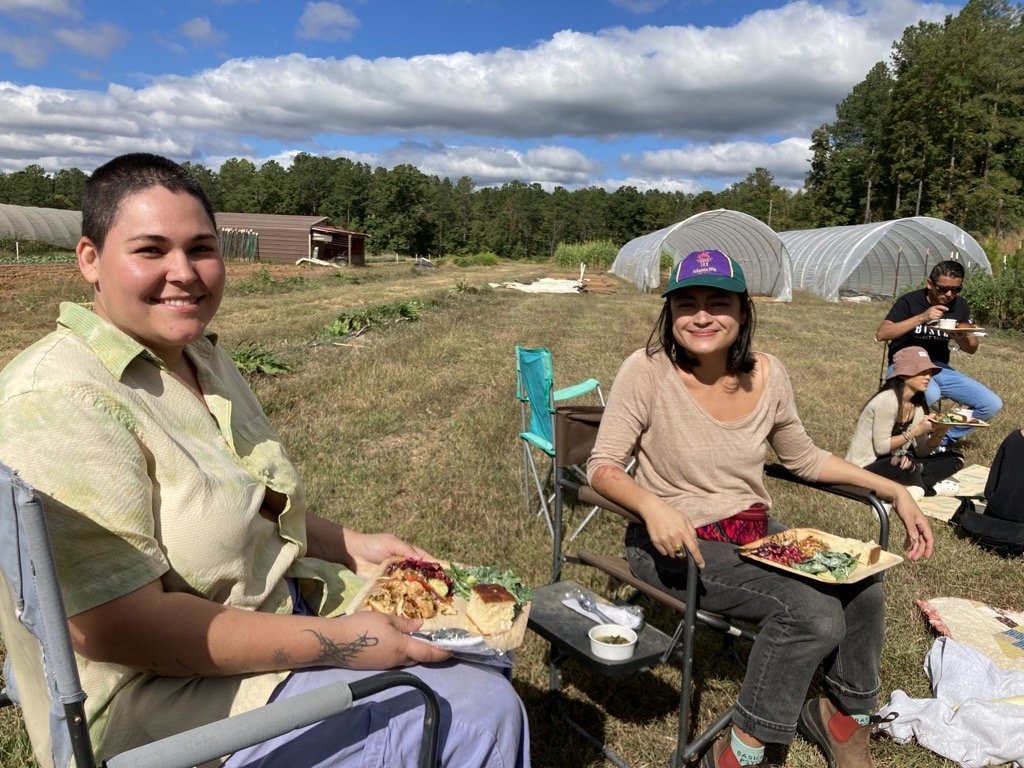
So, we got together at the beautiful Levity Farms in Madison, GA, exchanged insights and ideas, and shared an exquisite lunch catered by the local Hallie Jane’s Catering, who sourced much of the produce from Levity Farms!

Georgia Organics’ Kayla Williams and Lauren Cox

Local sourcing talk over lunch!

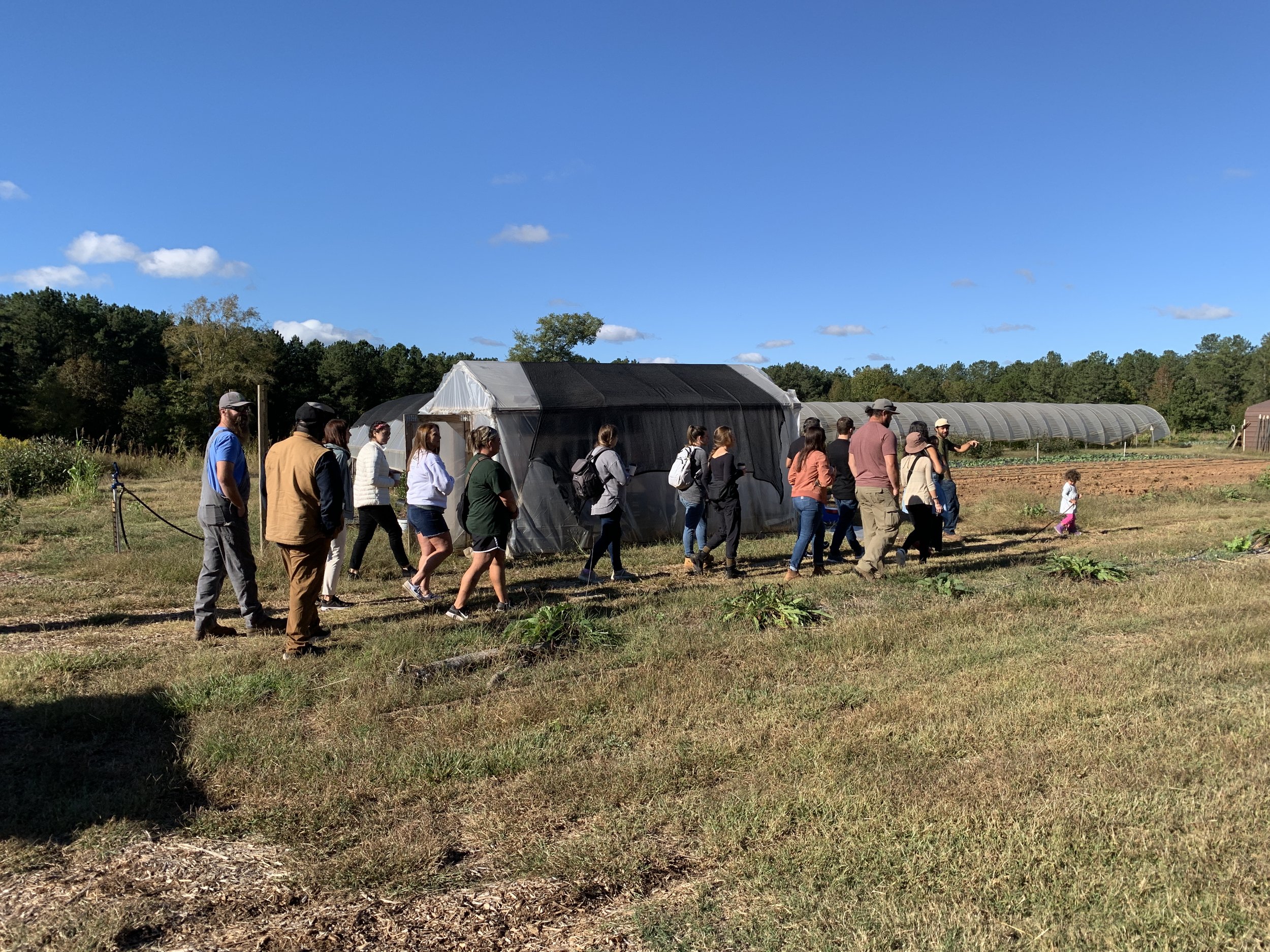
Our gracious farmer hosts, Zach and Ilana Richards took us on a tour, told us their story, and showed us how they build and maintain healthy soil and where they are in their progress towards a closed-circuit, regenerative farming operation.

Everybody shared what it is they look for when starting a new purchasing relationship and what is most conducive to maintaining those relationships. Farmers talked about what helps them when working with chefs; chefs talked about what helps them serve more locally grown food on their menus; and our ECE representatives talked about the challenges of sourcing the volume of food needed to feed many kids multiple meals on a daily basis and the opportunity to plan ahead. While everyone in the room could probably use more time and help, nobody was lacking in passion, care, and respect for each other and each other’s work.  

KEY TAKEAWAYS

Consistency and communication! 

  • For farmers:  

  • Send updated availability lists and/or check in consistently. 

  • Also, let your buyers know what’s coming up soon, and try to give them an idea of how long you’ll be able to offer different items on your availability list. 

  • For buyers:  

  • Consistent ordering: When farmers know they can count on a regular order for you, they will grow for you. 

  • Consistent communication: This is key to building trust and a solid relationship. 

  • Provide your farmers feedback on their product. They want to make you happy! 

Cultivating personal working relationships 

  • Community connection makes what we do magnetic.” So well said by Ilana Richards of Levity Farms! 

  • Build a symbiotic relationship. 

  • Check in with each other. 

Planning ahead helps everyone! 

  • Take some time to plan together and understand each other’s expectations. This helps chefs plan menus and gives farmers more information about what’s in high demand while they’re planning their season. 

  • Some purchasing relationships, like those between farmers and ECE providers might benefit from drawing up a simple contract. 

Georgia Organics’ Farmer Champion program works to bring local farmers, chefs, and aggregators together to increase sustainable and organic purchasing by Georgia restaurants, caterers, pop-ups, and early childhood education centers. By connecting farmers to these purchasers and eaters to these businesses that source responsibly, our local food system’s diverse patchwork of small and organic farms will grow and thrive. If you’re a buyer interested in learning more, please reach out to Kayla Williams at kayla@georgiaorganics.org and/or Kimberly Koogler at kimberlykoogler@georgiaorganics.org. 

To learn more about Levity Farms, visit www.levityfarms.com or follow them on social media at facebook.com/levityfarms and/or on Instagram at levityfarmsga. 

To learn more about Georgia Organics, visit georgiaorganics.org and follow us on social media @GeorgiaOrganics and at facebook.com/GeorgiaOrganics. 

Farmer Advocacy at Georgia Organics: The Next Commissioner of Agriculture

For the first time in 12 years, Georgians will elect a new commissioner of agriculture this November, with three candidates vying for the position that oversees, regulates, or assists with dozens of crucial aspects of the food and farming system in Georgia. Agriculture is the state’s leading industry, generating $74 billion in economic activity each year.

Recognizing this historic moment, and the lack of attention this important race typically garners, Georgia Organics invited all three candidates to tour a certified organic farm, get to know the organization and the local and organic food movement, and speak with five certified organic farmers.

The Democratic and Republican candidates both accepted this invitation, and agreed to allow Georgia Organics to publish the answers to a series of questions so that our constituents could have a better understanding of their stances on issues important to our growers and members.

Democratic candidate Nakita Hemingway met with us on Oct. 3, 2022, and Republican candidate Tyler Harper met with us on Oct. 7, 2022. The Libertarian candidate David Raudabaugh was invited to answer the same questions on two occasions through a portal on his campaign’s website and has yet to reply. If he does, we will promote his answers as well.

To learn more about Georgia Organics’ Farmer Advocacy work, visit georgiaorganics.org/advocacy.

From left to right, Demetrius Milling, Russell Honderd, Joe Reynolds, Monica Ponce, Nakita Hemingway, and Daryll Bartolome.

From left to right, Russell Honderd, Joe Reynolds, Tyler Harper, Monica Ponce, Judith Winfrey, Georgia Organics President and CEO Alice Rolls, Matthew Agvent, and Demitrius Milling.

To learn more about our Farmer Advocacy work, visit georgiaorganics.org/advocacy and sign up for our email newsletter, The Dirt, for updates at bit.ly/thedirtsignup.

Georgia Early Care and Education Harvest of the Month Initiative

We’re excited to share this guest blog post from one of our amazing partners at Quality Care for Children (QCC)!

By Monica Griffin MS, RD, LD

Monica Griffin is the Nutrition Early Care and Education Manager at Quality Care for Children. To learn more about Quality Care for Children, visit qualitycareforchildren.org and connect with us on social media @QCCGeorgia on Facebook, Instagram, and Twitter.

The Georgia Early Care and Education Harvest of the Month is a collaborative campaign to promote local, seasonal fruits and vegetables in child care settings.

The initiative is led by Quality Care for Children, Georgia Organics, and the Georgia Department of Early Care and Learning.

To support the state-wide initiative, Quality Care for Children has developed a variety of resources for child care providers, including:

  • Colorful poster available in English and Spanish

  • Cookbook featuring recipes created by Georgia child care providers

  • Dedicated webpage to promote each Harvest of the Month item, including classroom activity ideas, recipes, a book list, and a family newsletter available in both English and Spanish

  • Virtual and in-person training opportunities to help child care providers procure and prepare locally-grown foods, and to integrate gardening and food-based learning activities in the classroom

October’s Harvest of the Month item is spinach to align with Georgia Organics’ “Spinach to Win It!” campaign to get kids eating, growing and participating in Farm to ECE activities during National Farm to School Month.

Quality Care for Children’s October training calendar is focused on helping child care providers implement Farm to ECE programs:


To learn more about Georgia Organic’s Spinach to Win It! campaign, click here.

To learn more about Quality Care for Children, click here or contact Monica Griffin at Monica.Griffin@qccga.org.

Farm to School Innovation Mini-Grant Highlight: Addressing Health Equity through Farm to School Programs

Georgia Organics and the Georgia Department of Public Health (GA DPH) have partnered to establish the Farm to School Innovation Mini Grants Program.

These funds support farm to school initiatives that:  

  • Increase access to local, fresh, organically grown food,  

  • Include culturally responsive food and education,  

  • Increase local food procurement,  

  • And/or benefit Georgia-certified organic farmers in other ways.  

To learn more about the Farm to School Innovation Mini-Grant Program, click here.  

To financially support the Farm to School Innovation Mini-Grant, click here  

We are pleased to highlight Mini-Grant Awardee: Baldwin County Schools  

Baldwin County Schools Wellness Coordinator A'Keti Mayweather understands the tremendous impact that learning to cook and garden can have on the nutrition and overall health of Baldwin County students. That knowledge helps drive her passion and dedication to supporting a two-time platinum Golden Radish Award winning farm to school program in Baldwin County. 

Baldwin County students during a farm to school lesson.

A recent Baldwin County Junior Master Gardener (JMG) graduate!

Baldwin County School’s most recent farm to school innovations include a Junior Master Gardener program that engages children in novel, “hands-on” group and individual learning experiences that promote a love of gardening, develop an appreciation for the environment, and cultivate the mind.  

Last school year, in collaboration with FoodCorps Service Members, Baldwin County Schools offered two different Junior Master Gardener (JMG) certificate programs to certify students at Midway Hills Academy and Lakeview Academy. Eighteen Baldwin County students received their JMG Certification! 

This successful program, which A’keti believes will inspire students to further their agricultural education and join FFA (Future Farmers of America) will continue into the next school year.

Baldwin Home Gardening Kits

Baldwin County Schools will also continue to extend gardening education and opportunities to more students and families by offering seeds for fall and spring planting each year.

This innovative program is truly designed to increase health equity and access to good food in Baldwin County. 

To learn more about Baldwin County Schools’ Farm to School program, visit their webpage and follow them on social media @baldwincountyschoolnutrition 

Farmer Field Day Recap of Tractor Implements, Soil Health, and Wash Stations at Bugg Farm

By Ain Chiké 

Ain Chiké is a Georgia Organics Farmer Services Coordinator 

ACCELERATOR PROGRAM: 2022-2023 Accelerator applications are LIVE from August 1- September 12. Learn more about the year and a half long program and how you can qualify and apply here.   

Addis Bugg, Jr. and Addis Bugg, Sr. Photo Credit: The Common Market   

Last month on a warm Monday morning, the Georgia Organics Farmer Services team and about 10 farmers visited Bugg Farm in Pine Mountain, GA, to witness tractor implements in action and view the newly constructed wash station. During our stay, we learned about resting fields, considerations for building a wash station, weening cattle, and how the Georgia Organics Accelerator Program benefited Addis Bugg’s farm operations.  

Our day began with our gracious host and 2021-2022 Accelerator farmer Addis Bugg taking the attendees on a tractor-pulled hayride tour around the farm.  We gazed upon peach trees and muscadine vines sitting heavy with ripening fruit. Participants learned about the rich legacy of Bugg farm, of which Addis is the fifth generation to inherit and work the land. At one stop, Addis showcased the sabbatical field covered in bright green clover. 

Soil is a farm’s most valuable asset, and when we allow the soil to rest, it gives the Earth time to replenish nutrients that are leeched throughout a crop‘s development. Cover cropping fallow fields restores nitrogen, aids carbon sequestering, reduces erosion, and keeps pests at bay.  

Wash station BEFORE.

Wash station AFTER. photo Cred: Addis Bugg  

Our tour concluded at the newly built wash station partially funded through the Georgia Organics Accelerator Program. As we looked around the large, covered area, Addis mentioned his considerations before erecting the structure. Not wanting to build in a space where bacteria from uphill could wash downward, he noted how water flowed on the farm. A concrete base and roofing keeps water from pooling and floors from becoming slippery.

Every farm is unique, so here are some key points to consider for constructing a wash station:  

  • Do the components and design adhere to grant or certification requirements?  

  • What are the pros and cons of wooden, plastic, or steel materials? 

  • Where is the wash station in relation to the field and storage areas? 

  • What kind of flooring is best for my operation? Grass, gravel, or concrete? 

  • What is financially feasible for my farm and how much will I expand over the next 5-10 years Will the wash station become too small very quickly? 

  • How will I keep the area clean and free of standing water? 

  • Where does rainwater runoff go after a storm?  

  • Where is the sun and therefore heat, in relation to where I’ll be washing and packing produce?  

  • How can I streamline my set-up to work as quickly and efficiently as possible so that produce moves quickly from the field to the wash station and into the cooler? 

  • How can I keep things like bins and harvest crates off the ground at all times? 

  • Will I need a designated washing space for ‘dirtier’ root crops like turnips, radishes, or potatoes? 

In the final hour of our stay, Addis happily demonstrated the capabilities and usefulness of his new tiller attachment purchased with the funding granted to Accelerator farmers. Part of knowing which new farm tools to invest in came through the guidance of Georgia Organics’ Farm Services Director, Lauren Cox. Using educational material and a guided exercise, Addis and Lauren assessed three crops for profitability and prioritized tool purchases based on their findings. “I was breaking ground with an ancient harrow that I had to grease up every three rounds. This new tiller has helped out SO much.” As we stood by and watched Addis partially till a row, it was easy to see why he was grateful for the equipment.  

TRACTOR IMPLEMENTS: Learn more about choosing and using tractor implements with this great resource from Vern Grubinger, Sustainable Vegetable Production: From Startup to Market (PDF pages 103-111) 

IMPLEMENT MAINTAINANCE: Consistent maintenance is important when it comes to extending the life and quality of your tractor implements. Check out this maintenance log template for recording scheduled cleaning, etc.  

ACCELERATOR PROGRAM: 2022-2023 Accelerator applications are LIVE from August 1- September 12. Learn more about the year and a half long program and how you can qualify and apply here.   

Last but not least, click to learn more about Bugg Farm visit their webpage or follow Bugg Family Farm on Facebook. 

To learn more about Georgia Organics, visit georgiaorganics.org and follow us on Instagram @GeorgiaOrganics, Twitter @GeorgiaOrganics, and at www.Facebook.com/GeorgiaOrganics. 

2022 Barbara Petit Pollinator Award Winner Robby Astrove 

By Mary Elizabeth Kidd  

Mary Elizabeth is Georgia Organics’ Director of Communications 

 All photography by Ginger & Carrot Productions

The Barbara Petit Pollinator Award is named in honor of Barbara Petit, a remarkable community food advocate who served as Georgia Organics' past president. This award acknowledges individuals who are successfully advancing—pollinating—Georgia Organics' key tenants: farmer prosperity, healthy soil, and resilient communities.  

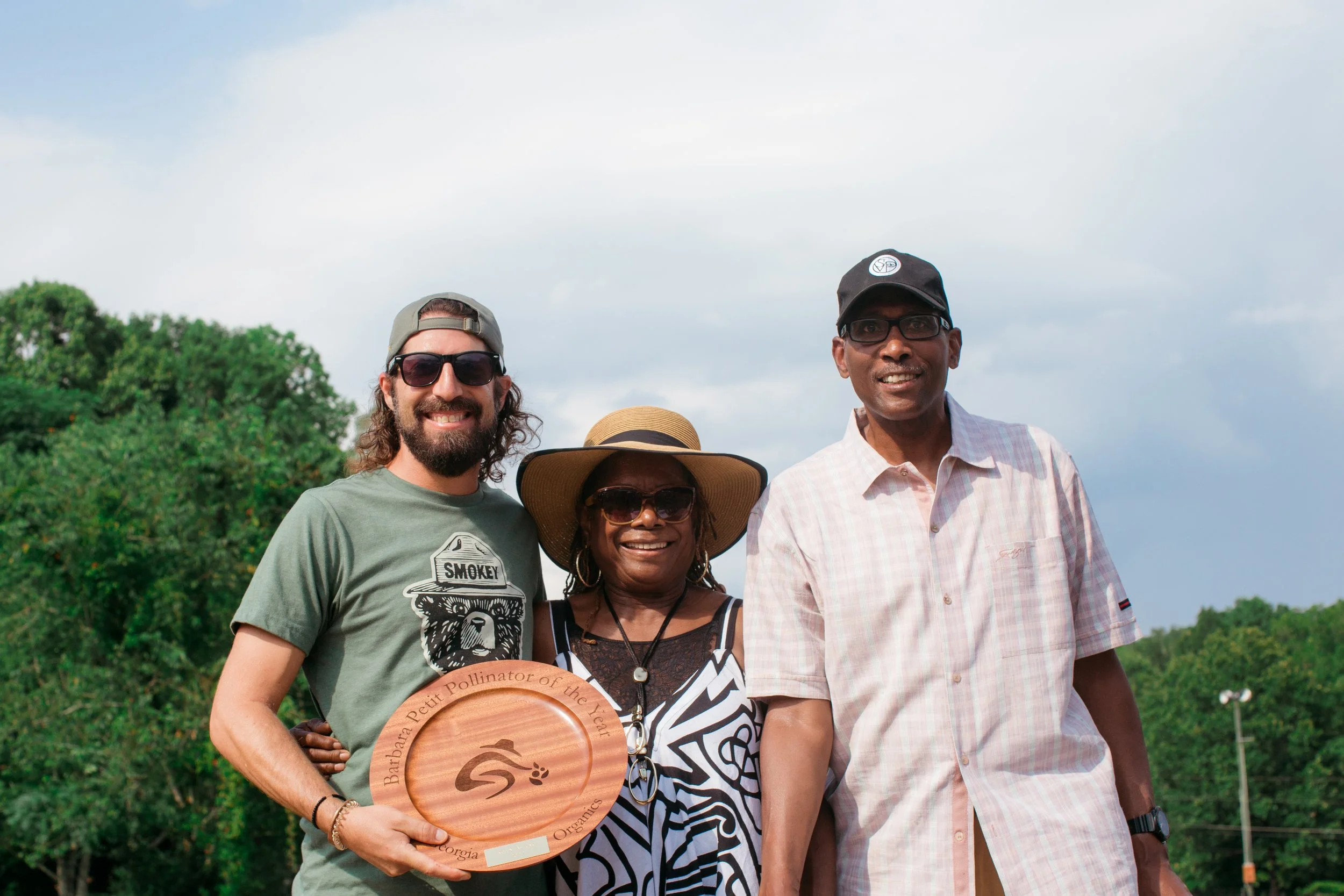
The 2022 Barbara Petit Pollinator Award winner is Robby Astrove, Preserve Manager at the Davidson-Arabia Mountain Nature Preserve and the so-called “Johnny Appleseed” of Atlanta.  

“Robby is what I’d call a ‘creative instigator.’” 

Georgia Organics’ President & CEO Alice Rolls continues, “wherever he goes, he brings charisma, a smile, and a giving spirit.” 

When asked what drives his creative and connective work, Robby Astrove cites curiosity as one of, if not the key ingredients in his life and career, even from an early age. “Even as a little kid I was always looking out the window,” he says. 

Robby grew up in South Florida, playing outside and developing an early understanding of the ecosystems in his own backyard. “I can remember in the fifth grade we took a field trip to the Everglades and I was captivated by it. Not just the ecology, but also the freedom of learning in that space; the fact that we could be ‘in school’ and outdoors.” 

His love of the natural world only grew in high school and college. He jokingly references his high school science fair project on the “Fire Tolerance of the Silver Palm,” which read more like scientific research than homework. In college, he charted the course for a new interdisciplinary degree in Florida State University’s School of Geography. His subjects covered city planning, hydrology, native plants and more. 

The Florida Everglades and the Kissimmee River served as a natural home base for Robby. This was the site of his first “lightbulb moment” on ecological transformation; it was the topic of his 50-page college paper and was the place his career as an ecologist and educator took root. His first job was on the Kissimmee River where he provided topographical data that would eventually lead to the restoration of the river.  He returned to the Everglades watershed again after pursuing a graduate degree from Western Washington University.  In this role Robby planted cypress and pond apple trees with K-12 students in Lake Okeechobee.  All told, he served as an educator, survey technician, tree planter, and researcher for non-profits, universities, and environmental consultants in this formational stage of his career.  

Whether attending conservation conferences or educating Everglades visitors, Robby noted a gap between the urgent concerns of environmental scientists and the average person’s awareness and understanding of the current threats to the natural world and how anyone can affect change in conserving our natural resources.  

Within this space between science and citizen action, Robby recognized his role as a translator or bridge for systems change. “If behavior change doesn’t happen, species disappear.” 

In 2007, Robby relocated to Atlanta to become an Education Coordinator at Trees Atlanta, directing youth and adult programs on urban forestry restoration and environmental education. From there, his success as an Atlanta transplant in the conservation and local food movement would only grow exponentially. 

His lasting impact on Georgia’s food system and environment would only be cemented as he had founding and early roles in the Atlanta Local Food Initiative (ALFI), the ALFI Incredible Edible Fruit Tree Sale, The Orchard Project, and Concrete Jungle. He continues to serve as one of the city’s finest foragers and educates thousands of visitors in his primary job as Preserve Manager at the the Davidson-Arabia Mountain Nature Preserve. 

“Robby has been a perennial champion in Georgia's good food scene and has led workshops for Georgia Organics and numerous other groups and communities over the past 15 years.  If Georgia Organics recognized Robby, people would come out of the woodwork to join with us and celebrate him because his spirit and passion move people and his track record is undeniable.” concludes Alice Rolls. 

Read more about Robby’s impactful Atlanta work here and here and here, but first, enjoy this short conversation with this year’s Pollinator Award winner, including his memories of the award’s namesake, the late Barbara Petit. 

Georgia Organics 2022 Pollinator Awardee Robby Astrove with 2021 winners Gwendolyn and Brennan Washington of Phoenix Gardens. Photo by Jenna Shea Photojournalism.

How did you bridge the space between environmental education and Atlanta’s local food movement? 

Around the time I came to Atlanta, I started seeing that the food movement around this time was almost one-upping the environmental movement, even tackling issues of justice and equity. The local food space felt more approachable and that it could make a difference. This was reinforced by seeing the success of folks like Erin Croom establishing Georgia Organics’ Farm to School program and Georgia Organics growing as an organization. 

Fruit trees really were the bridge between the environment and food spaces. While I was planting trees through Trees Atlanta, I got close to Ebrima Ba in the West End, who created the “Food, Clothing, and Shelter” documentary, and he advised me to start planting fruit trees instead; people were hungry.  

Where will Robby Astrove be in 10 years? And what is your hope for a future Atlanta and Georgia food system? 

I don’t have a crystal ball, but one thing you can count on is I’ll still be planting. I joked with a friend the other day that if ever I stop planting, they should come and shake me, something is wrong. 

As for the future Georgia food system, I definitely hope we have a different food system than we do today. I want to see farmers and growers more respected, but not only that, better cared for, both from inside and outside our industry. They need to be seen and revered more as mission critical members of our society. 

I also hope that consumers' choices change. And eventually, of course, policy. 

How does your current work feed into this future vision?  

I see my role as multipronged. I’m an educator, a connector—a cross-pollinator, like this award—and I finally feel like I carry some influence in this movement, like people can listen to me. This is also where mentorship comes in. I’ve spent a lot of time seeking out elders, mentors; I hope I can be a mentor, no matter what age folks are, I want to make sure we’re all carrying the torch forward. 

You shared in your awards video that Barbara Petit (see below), after whom this award is named, was instrumental in what you’re doing today. What are a few things/lessons you learned from her? 

My memories of working with her were really about witnessing her leadership and how she brought people together...She was someone with vision and incredible drive. I have so much love and respect for her. She is really who gave me the blessing, the head nod, to start the orchard project, and I was down to do it. 

It was Barbara who directly told me: ‘don’t stop planting.’ And that’s my plan. 

To hear more from Robby and learn more about the Barbara Petit Pollinator Award, click below. 

 RELATED STORIES:

Advocacy Efforts Bring Top USDA Officials to Georgia

By Michael Wall

Certified organic farmers in Georgia have been hit with a perfect storm of challenges over the past few months that have made organic certification even harder to achieve and maintain than ever before.

Those challenges include major disruptions to the Organic Certification Cost Share Program (OCCSP) that now force farmers to apply for cost share support twice, through two separate application projects.

The process prior to 2020 reimbursed farmers for 75 percent of their certification costs, up to $750, with only one annual application. In a move that surprised and angered many agricultural leaders in Congress, not to mention farmers themselves the USDA Farm Service Agency reduced the reimbursements to $500 with no public input and little warning to growers.

The FSA change to organic cost share came in the first few months of the Corona-virus outbreak, which was also a time of great marketplace upheaval for restaurants and growers alike. And while this was going on, some certification agencies raised their prices so drastically that many long-time certified organic growers contemplated surrendering their organic certificates.

In February of 2022, Georgia Organics Farmer Advocate Michael Wall was able to share these challenges with USDA Undersecretary of Marketing and Regulatory Programs Jennifer Lester Moffitt in a virtual coffee chat, prompting Moffitt to travel to Crystal Organic Farm in Newborn, Georgia and hear from Georgia Organics farmers first hand.

On March 2, Moffitt visited with Georgia Organics and farmers Russell Brydson (Narrow Way Farm), Celia Barrs (Woodland Gardens), and Nicholas Donck (Crystal Organic Farm) to discuss rising certification costs and easing the barriers to achieving and maintaining organic certification.

During the meeting Moffitt outlined a new USDA initiative that would offer additional support for organic growers, and the conversation ranged from reimbursements and cost shares to certifier customer service, and the lack thereof. Moffitt was also extremely interested in learning more about Georgia Organics’ Accelerator program, 200 Organic Farms work, and the many obstacles organic farmers face in Georgia and the Southeast United States.

Moffitt, who began serving as the undersecretary on Aug. 11, 2021, grew up on and eventually ran a certified organic family walnut farm in California. Mofitt now oversees the division of the USDA that administers the National Organic Program, and many others, including domestic and international marketing of U.S. agricultural products, plant and animal health, genetically engineered organisms regulations, the Animal Welfare Act, and wildlife damage management.

The USDA recently released more details on the organic transitioning program Moffitt alluded to. While more details are needed, the new Organic Transition Initiative appears to be a much-needed commitment from the USDA to level the playing field for farmers seeking to achieve organic certification.

Lastly, the interaction with Moffitt and subsequent USDA actions to support organic agriculture confirm that advocacy efforts, as requested by Georgia Organics’ constituents, are an important part of the organization’s commitment to organic farmer prosperity.

The Organic Certification Cost Share Program will remain one of Georgia Organics’ top advocacy priorities as 2023 Farm Bill discussions heat up. Georgia Organics will continue to push for meaningful advances in the Farm Bill alongside its allies, especially the National Sustainable Coalition, which provided Georgia Organics with a grant to begin its farmer advocacy efforts, and the Organic Trade Association, upon whose Farmer Advisory Council, Climate Change Task Force, and Diversity Council Georgia Organics sits.

G.O. Goes to Washington to Support Organic Farmers

By Michael Wall

Michael Wall is Georgia Organics’ Director of Advocacy and previous Director of Farmer Services.

Georgia Organics Farmer Advocate Michael Wall and Albany organic farmer and Georgia Organics board member Sed Rowe asked federal lawmakers for more institutional support for organic growers on a March trip to Washington, D.C.

During the Organic Trade Association’s Organic Week and Advocacy Day, Rowe and Wall met with lawmakers or their staff from the offices of Rev. Sen. Raphael Warnock​, Rep. Nikema Williams​, Rep. Sanford Bishop​, and Sen. Mitch McConnel.

Farmer Sed Rowe and Farmer Advocate Michael Wall with staff members of Rep. Nikema Williams office on Capitol Hill in Washington, D.C.

The top priorities Rowe and Wall discussed with lawmakers included much-needed improvements to the Organic Certification Cost Share Program (OCCSP), which has been diminshed by recent changes enacted by the USDA Farm Service Agency. Also, they asked for the full amount of funding that has already been approved for the Sustainable Agriculture Research and Education (SARE), program, the continuous improvement of the National Organic Program, continued funding for the OAO 2501 program and its support of BIPOC growers, and funding for organic research.

Farmer Advocate Michael Wall and National Sustainable Agriculture Coalition Director Sarah Hackney, who has participated in and presented at numerous Georgia Organics Annual Conferences.

The meetings were either beginning or continuing important relationships that could benefit Georgia Organics’ farm members, especially during upcoming Farm Bill discussions, which have already kicked off with several U.S. House Agriculture Committee hearings.
In addition to the Capitol Hill visits, Rowe was also a panelist during a State Organic Network session and talked about his organic and hemp accomplishments achieved in partnership with Georgia Organics. And, Wall participated in several meetings as a member of OTA’s Farmers Advisory Council, Climate Change Task Force, and Diversity Committee. He also took the time in D.C. to meet with long-time partners at the National Sustainable Agriculture Coalition (NSAC), which has worked hard for decades to forge the Farm Bill into legislation that puts organic farmers on equal footing with the rest of American agriculture.

To keep up with the Farm Bill and many other critical agriculture bills, sign up to receive NSAC’s weekly newsletters here, and learn more about the Farm Bill here.

Georgia Organics Launches Farmer Advocacy

By Michael Wall

Michael Wall is Georgia Organics’ Director of Advocacy and previous Director of Farmer Services.

As a non-profit, Georgia Organics updates its strategic plan every five years to ensure it remains on track with its mission, values, and farmer-focused programming.

Typically, the board of directors, key constituents, and important partners are interviewed to assess the changing landscape that Georgia Organics operates within, and the needs of the community that Georgia Organics attempts to serve.'

One of the surprising elements that emerged from these discussions in the most recent strategic plan was a strong direction for Georgia Organics to re-launch its advocacy efforts, this time with a singular focus on farmer prosperity.

To that end, and after months of conversations and planning within the Georgia Organics offices, Lauren Cox was promoted to Director of Farmer Services, and Michael Wall moved over to the new position of Director of Farmer Advocacy.
It must be noted that advocacy is not a brand-new effort for Georgia Organics.

Roughly 10 years ago, Georgia Organics had an Advocacy Director, Jennifer Owens, who addressed small-scale poultry processing, early Farm to School efforts, and many other important topics. Also, the Atlanta Local Food Initiative, another Georgia Organics initiative under the leadership of now Director of Programs Suzanne Girdner, also engaged in policy work that gave rise the City of Atlanta’s urban agriculture legislation and later the city’s first Urban Agriculture director position.

Wall and other members of the farmer services team, including Donn Cooper and Tenisio Seanima, and the board of directors, such as farmer Joe Reynolds of Love is Love Farm Collective, have worked on advocacy in the past, especially around the Farm Bill, SARE and NRCS funding, and the Organic Cost Share Reimbursement Program.

The strategic plan was approved by the Georgia Organics board of directors on Nov. 8, 2021, and includes several key themes that pertain to advocacy, partnerships, and movement building, especially around farmer prosperity, racial justice, and climate change.

For example, one of the plan’s goal states that Georgia Organics work would:
“Grow an influential network of advocates who champion organic and regenerative farmers.”

Other key themes from the Strategic Plan summary related to Farmer Advocacy work:

  • Move from program building to movement building. Step fully into our role as a convening and advocacy organization. 

  • Foster strong partnerships, and together pursue collective impact strategies.

  • Become an integral part of Georgia’s climate change solutions.

A summary of the strategic plan is below.

So far, Georgia Organics Farmer Advocacy work has been based on strong existing partnerships and previous advocacy experience, especially around the Farm Bill with partners such as the National Sustainable Agriculture Coalition and the Organic Trade Association. In March, Wall and organic farmer and board member Sed Rowe traveled to Washington, D.C., and met with federal lawmakers about the Farm Bill and the needs of Georgia’s organic farmers.

Georgia Organics and a handful of farmers also been hosted USDA Undersecretary Jennifer Lester Moffitt to discuss much-needed improvements to the Organic Cost Share Reimbursement Program, and the upcoming Organic Transitioning Initiative, which will have $300 million devoted to support farmers seeking organic certification.

Most importantly, Georgia Organics’ advocacy agenda will be set by its most important constituents: farmers. Over the Spring and early summer of 2022, Georgia Organics distributed a survey to more than 1,000 farmers to determine their highest policy priorities.

That survey will be finalized and analyzed over the coming weeks, and a report will be shared with Georgia Organics’ farmer members and partners.

2022-2026 STRATEGIC PLAN 

Key Themes and Shifts that Emerged from Internal and External Reviews:

  • Champion diversity, equity and inclusion internally and externally, working towards becoming an anti-racist organization  

  • Move from program building to movement building. Step fully into our role as a convening and advocacy organization.   

  • Invest in farmers, especially Black farmers, and local food communities.   

  • Refocus core programs by regionalizing/localizing work and centering on farmer prosperity.   

  • Foster strong partnerships, and together pursue collective impact strategies. 

  • Use the power of storytelling to recruit more advocates and members to the movement.  

  • Become an integral part of Georgia’s climate change solutions.   

  • Re-envision and reshape The Farmer Fund to increase impact.    

  • Expand and diversify revenue streams, including unrestricted revenue and fee-based services.  

  • Organize, invest in, and develop staff and board to ensure needed skills, aligning with the organization’s values and capacity to achieve goals.  

  • Consider these delivery mechanisms and ways to build the movement: direct services; partnerships; investment; convening and peer-to-peer services; advocacy. 

VISION

All Georgia farmers nurture and heal the land, people, and communities.   

MISSION 

Georgia Organics invests in organic farmers for the health of our communities and the land. 

VALUES


Farmer Prosperity  

We believe that thriving farmers are the catalyst for a transformed world playing the central role in the interdependency between restored soil, thriving people, stronger communities, and healthier environment.   

Soil Health and Environmental Stewardship 

We believe agriculture should use soil-building farming practices, and steward our air, land, and water resources.  

Anti-Racism  

We believe in working intentionally, consistently, and collaboratively to transform our food system, our farming system, and our own organization to one that is anti-racist, multi-cultural, diverse, and just.  

Community & Collective Impact 

We believe in the inherent talents, passions, and wisdom that exist in communities and our partners in the local food movement. We believe working collectively is essential to transforming our food system to be healthy, local and organic. 

Climate Action 

We believe organic farming is a critical solution to sequester carbon in our soil and mitigate the catastrophic impacts of climate change on people and ecosystems.    

Public Health 

We believe that public health begins in the soil where our food is grown and raised and organic farmers are stewards of our health and should be recognized and supported accordingly. 

New Guest Post! School Garden-to-Market: Wonder Isn’t Just for Kids 

By Dawn Grantham 

Dawn Grantham is a Partner in Education consultant at Columbus State University. 

Note: Because of its supportive principal, Dr. Dawn Jenkins, and its ingenuity in organizing a school garden with very little outside resources, South Columbus Elementary School (SCES) was one of two schools in Columbus, Georgia, selected to participate in a school garden-to-market initiative as part of a USDA Farm to School Grant awarded to Georgia Organics. The grant required schools to partner with a local farmer, whose charge was to guide students in the planting, growing, harvesting, marketing and selling of produce grown on the school campus.  

“Never doubt that a small group of thoughtful, committed citizens can change the world: indeed, it’s the only thing that ever has.” -Margaret Mead, anthropologist, recipient of the Planetary Citizen of the Year Award in 1978. 

One happy Market Day participant. Photo credit, all images: Jenna Shea Photojournalism.

We met in the school’s library. We sat in child-friendly chairs, that cut slightly across our lower backs, at child-friendly tables, where our bent knees either nudged the table underside or rested at the table edge. We talked. We planned. We brainstormed. We scheduled.  

Here, we gathered: the local farmers, the assistant principal and four classroom teachers, a supportive parent, the school district’s nutritionist, the grant representative, the local extension agent, and me. We formed the school garden-to-market committee, known as Eagles Go Green! (EGG!).  

For an hour, once a month from November 2021 to May 2022, we emphasized hands-on opportunities for students with the farmers, and we created lists of experts from the community to invite to the school to tie their knowledge of agricultural and environmental practices to curriculum state standards. In our meetings, we agreed to survey students and staff to direct our course. We reserved dates to dig, plant, harvest, play, and to celebrate.

For promotional purposes, we approved a kick-off event, video productions, scheduled photographers, and a t-shirt design. For fun, and because we valued fine arts, we outlined the integration of an art project. We met and we talked and planned and we brainstormed, and very early in our collaboration, we quickly forgot that cultivating a school garden is hard work.  

We let go, and we leaned in. We each yielded and stepped up into the ebb and flow of a collaborative process, trusting wherever it took us. Our personal visions retreated as the project took on its own life. And, whatever our initial apprehensions – perhaps, it was the time commitment, or the expansive scope of the school-to-market project, even the challenge of managing 313 students – they dissolved.  

Farmer Jenn Collins helps with a selection of seeds. Photo credit Jenna Shea Photojournalism.

Some small miracles occurred. Funding from the grant allowed the farmers to plant a campus orchard of fruit trees and bushes, an item that had been on the school’s wish list for years. In working alongside the farmers and through easy conversations and simple gardening instructions, students began talking about careers in agriculture.

Because of the students’ curiosity and willingness to participate, Assistant Principal Vicci Griffin noted that EGG! “extended the four walls of the classroom allowing a natural gradual release of learning”; Principal Dawn Jenkins shared that it “was a dream come true” because the development of EGG! brought her students and the school to a level of real-world learning.

What we all plainly saw as significant in the unfolding of the school garden-to-market experience was an element of awe not only among the students but also among the adults, who were brought back into the hold of wonder and learning. It's amazing how beautiful vegetables are when you truly see them again for the first time: color, shape, aroma, taste, texture. 

On Friday, May 13, 2022, a combined EGG! Market Day and Field Day took place at South Columbus Elementary School.

Jenna Mobley, photographer and Georgia Organics contributor, captured beautiful faces, focused efforts, and generous spirits of the market experience through her photographs.  

In collaboration with the EGG! student marketing team, coached by school paraprofessional, Jakira Palmer, Farmer Brad Barnes and Farmer Jenn Collins, the married team of Dew Point Farms, organized an attractive market display of produce from both the school’s garden and from their farm. The students made well over their monetary goal of $200. 

Across the sidewalk, art teacher Alexandra Countryman reminded students of their study of local artist, Alma Thomas, and then gave painting instructions while UGA Extension Agent, Ashley Brantley, and Jada Bone, Muscogee County School District’s nutritionist, fitted students into smocks. Shelia Brown, a master gardener volunteer, helped direct paint strokes on the two community canvases; Muscogee County School District's Content Specialist for Art Education, Dr. McCullough, offered district support. 

Principal Jenkins and 5th grade teacher Patrice Blassingame, with a bird's eye view of the field, kept the flow of shoppers, artists, spectators and athletes on schedule and in the right place. 

The SCES staff, led by their EGG! Committee colleagues, Amanda Joiner, Patrice Blassingame, and Deidre Howell, visibly supported the school garden-to-market project from beginning to end.  

And, Kimberly Della Donna and Kimberly Koogler of the Georgia Organics Farm to School program, were both on the EGG! Market Day scene to join in the celebration of farmers, young and seasoned. 

In organizing South Columbus Elementary School’s school garden-to-market experience, EGG!, it was easy to make an agenda and keep people to their speaking parts. We easily recognized that a garden’s success requires effort and time to experiment; it requires specific tools and materials and growing strategies, and it requires committed people. But, what was a little more challenging, and certainly out of any one individual’s control, was the development of synergy that came with the understanding and appreciation that the project was bigger than any one of us. Again, we learned to trust the process, and in doing so, we established an expectation, relied on the skill sets of new friends, and faced a daunting project together.  

The wonder of it all! 

Farm to School Innovation Mini-Grant Highlight: Addressing Health Equity through Farm to School Programs 

By Kimberly Della Donna 

Kimberly Della Donna is the Farm to School Director at Georgia Organics   

Georgia Organics and the Georgia Department of Public Health (GA DPH) have partnered to establish the Farm to School Innovation Mini Grants Program. These funds support farm to school initiatives that:  

  • Increase access to local, fresh, organically grown food,  

  • Include culturally responsive food and education,  

  • Increase local food procurement,  

  • And/or benefit Georgia-certified organic farmers in other ways.  

To learn more about the Farm to School Innovation Mini-Grant Program click here.  

To financially support the Farm to School Innovation Mini-Grant, click here  

We are pleased to highlight Mini-Grant Awardee:

Douglas County School System (DCSS) 

DCCS Training and Development Manager Tempest Harris’ work includes championing an award-winning, district-wide farm to school program. Last summer, she created and developed the Farm to School Expo initiative with the help of internal and community stakeholders.

While DCCS had success for many years in infusing local foods in meals, promotions, and taste tests throughout the district, they recognized that not all schools in the district had comprehensive food education programs.

They developed a Farm to School Expo to address the inequity of that disparity and strengthen the farm to school program district-wide.  

Students were invited to participate in the First Farm to School Expo where they could meet various farmers from their community, learn about what they produce, explore animals, bees, butterflies, and composting, meet community partners who support agriculture education, and enjoy taste tests of traditional Ghanian foods such as Bissap, Jollof, and Kelewele. Students also received a “take-home bag" loaded with educational materials, seeds, guidance for growing foods at home, information on local farmers' markets and local farmers', and food resources. The resources empowered students to increase their knowledge of food sourcing and access points for fresh food. 

The exposure that the Expo offered administrators, staff, and students to the benefits of active farm to school programs increased interest in and demand for food and agriculture education in Douglas County Schools that currently don’t have those programs.

One attendee noted, “I would like to expose students to growing their own food. There are many agricultural paths that students can study to make our food better as well. Hopefully, students will see the importance of farming to our world.” With so many community partners and farmers involved in the event, community support seems ripe to satisfy the demand. In the words of one attendee “This was a wonderful experience for both the students and myself.”  

To learn more about Douglas County School Systems, visit dcssga.org/departments/school_nutrition  and follow them on social media  and at facebook.com/ douglascountyschools.