SUMMIT 2021—Using Farm to Early Care and Education to Move, Play, and Learn with Ms. Ladybug

By Yaza Sarieh  

Yaza Sarieh is a contractor for Farm to School at Georgia Organics and a Childhood Health and Wellness intern at the Georgia Department of Public Health.

Sign up today for the eighth annual Georgia Farm to School and Early Care and Education Summit, held virtually from Tuesday, April 27 through Saturday, May 1. The Summit features dynamic education sessions highlighting gardening, cooking with kids, local procurement, curriculum integration, and more! This event is hosted by Georgia Organics and the Georgia Department of Early Care and Learning.


Photos courtesy of Ms. Ladybug

Photos courtesy of Ms. Ladybug

“I am so excited to see all of the wonderful human beings at Summit who make such an impact in Georgia F2ECE. When you embrace F2ECE as part of your mission, it opens lots of possibilities and safe, entertaining, healthy doors with loads of positive outcomes for children.”  

Ms. Ladybug is the embodiment of her name—she is a garden-warrior and an exuberant advocate for F2ECE as a means of teaching children about the world around them.

Her tried-and-true methods of engaging with children focus on elevating children’s voices first, then using a silly, fun framework to get them excited about nature and the garden.

For example, to inspire students to eat fruits and vegetables, she gets them thinking by taking them outside to watch what worms eat. She asks questions like, ‘Do the worms like cheese? Or do they really like kale and watermelon?’ Ultimately, she has found that when students connect with nature and nutritious foods through these types of observations, they aspire to eat more nutritious foods too!  

Photos courtesy of Ms. Ladybug

Photos courtesy of Ms. Ladybug

In addition, F2ECE has been a way for Ms. Ladybug to contextualize complex societal issues while promoting diversity and equity.

Photos courtesy of Ms. Ladybug

Photos courtesy of Ms. Ladybug

When the students are in the garden, Ms. Ladybug prompts them to notice individual plant needs and how some plants differ from others. This activity allows students to visualize equity. She invites the students to celebrate these differences and recognize the beauty and purpose that each plant gives to its ecosystem.

Ms. Ladybug believes that F2ECE not only provides students with a way to understand the world but that these meaningful connections teach them to care for their own and each other’s well-being.   

During Ms. Ladybug’s Summit session, she will present creative and captivating ways in which you can incorporate simple F2ECE lessons into your daily activities.  


Sign up today for the eighth annual Georgia Farm to School and Early Care and Education Summit, held virtually from Tuesday, April 27 through Saturday, May 1. The Summit features dynamic education sessions highlighting gardening, cooking with kids, local procurement, curriculum integration, and more! This event is hosted by Georgia Organics and the Georgia Department of Early Care and Learning.

SUMMIT 2021—Early Care & Education Provider Wande Okunoren-Meadows: “Farm to ECE is Beneficial for the Whole Child”

Photo courtesy of Little Ones Learning Center, credit: Linden Tree Photography.

Photo courtesy of Little Ones Learning Center, credit: Linden Tree Photography.

By Yaza Sarieh 

Yaza Sarieh is a contractor for Farm to School at Georgia Organics and a Childhood Health and Wellness intern at the Georgia Department of Public Health. To learn more about Georgia Organics, visit www.georgiaorganics.org and follow us on Instagram @GeorgiaOrganicsTwitter @GeorgiaOrganics, and at www.Facebook.com/GeorgiaOrganics.  


“There is no right or wrong answer to Farm to School/ECE—as long as you’re doing something, you’re doing the right thing.”  

Wande Okunoren-Meadows is the director and educator at Little Ones Learning Center in Forest Park, where she utilizes Farm to Early Care and Education (ECE) practices to support the development of the whole child.

Photo courtesy of Little Ones Learning Center, credit: Linden Tree Photography.

Photo courtesy of Little Ones Learning Center, credit: Linden Tree Photography.

Especially amid the COVID-19 Pandemic, Wande believes Farm to ECE has been crucial for her students' health and well-being by boosting their immune systems, helping their mental health, and continuing their love of nutrition and environmental education.  

One of the components of Farm to ECE that Wande appreciates the most is how it creates a foundation for life-long respect and value of nature among her students:  

“Farm to ECE is holistic, inclusive, and incorporates everything a child needs for their development that you may never have thought of before. I love seeing our students engage with nature on a daily basis in the garden, where they watch life grow and develop a sense of environmental responsibility. If our children love and value nature as much as their Nikes, then we are winning.” 


Wande will be one of the speakers at this year’s Summit, where she will discuss ways Farm to ECE can address inequities and communal needs while also providing us with tips for Farm to ECE best practices in the classroom. Visit our website to learn more and don’t forget to register

Photo courtesy of Little Ones Learning Center, credit: Linden Tree Photography.

Photo courtesy of Little Ones Learning Center, credit: Linden Tree Photography.

Good Food for Thought: Spring Forward - Planning & Prepping Your Summer Garden with Joe Reynolds & Special Guests

By Caroline Croland

Caroline Croland is the Fundraising Coordinator at Georgia Organics. To learn more about Georgia Organics, visit www.georgiaorganics.org and follow us on Instagram @GeorgiaOrganicsTwitter @GeorgiaOrganics, and at www.Facebook.com/GeorgiaOrganics. 

Spring is upon us, and Georgia Organics was lucky enough to ring in the season with a gardening workshop! On March 14, farmer and former Georgia Organics Board Chair Joe Reynolds and co-manager Demetrius Milling of Love is Love Farm at Gaia Gardens shared their green thumb expertise in a live virtual demonstration, demonstrating how to plan and prepare a successful spring garden. Additionally, Laura Diaz-Villaquiran, FoodCorps Service Member, shared some tips and tricks on how to get your little ones in on the gardening fun by demonstrating how to create seed tapes and transplant lavender. This event was free for Georgia Organics members; if you want access to free and discounted events, sign up as a member today!

"We are at a critical time for getting ready for gardening- the days are longer, the sun is shining brighter, the soil is beginning to warm, and our very important planning time is beginning to ebb away," said Joe.  

With that in mind, let's dig in! Here's a rundown of a few of the planning tips covered in the webinar.  

Photo of Love is Love at Gaia Gardens, courtesy of Jenna Shea Photography.

Photo of Love is Love at Gaia Gardens, courtesy of Jenna Shea Photography.

Having a Game Plan

Step one for starting a garden is creating a game plan. This plan's level of detail will vary from garden to garden, but it all boils down to tracking your planting activities. What are you planting? Where are you planting? When are you doing your planting and harvesting?  

The sophistication of your plan is up to you! You can create notes in your phone, keep a journal, a spreadsheet, or sketch it out on a legal pad- the point is to start your gardening journey off with the habit of creating a record of what you did, and ultimately, what did and did not work for you. This will ensure that you can create a more informed gardening plan in the years to come.

Where to Plant?

To ensure healthy plants, be sure to choose a space that gets 8-10 hours of sunlight. If you find yourself tethered to an area that gets less than that, you may need to make some adjustments regarding how many plants or which plants you choose to grow. Herbs, for example, are much more tolerant of low light

Another consideration is your orientation. A southern orientation is going to give you more sunlight.

Water is another essential factor. Are you putting your garden way out in your yard in a place where it will be inconvenient to water?

Once you find that perfect spot and build or mark your perimeter, take your tape measurer and divide that space into a grid divided by the square foot. This grid will help you determine the number of plants you can fit into your space. Once you map out your space, you'll be ready to start thinking about what kind of garden you will plant.

Raised Beds vs. in Ground Planting: What kind of Garden to Construct? 

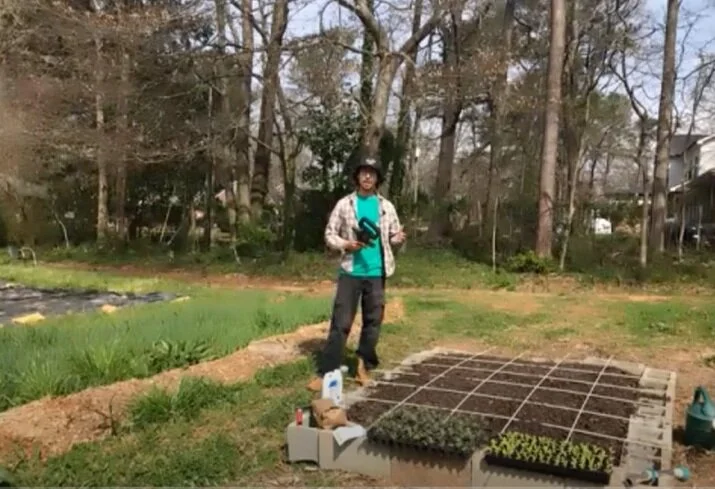
Demetrius Milling demonstrating how to grid off your raised bed. Photo from Spring Forward.

Demetrius Milling demonstrating how to grid off your raised bed. Photo from Spring Forward.

One popular gardening option is to construct a raised bed. To do this, you need to place a tarp over the native soil of your yard. Next, you will create a buffer. In the webinar example, Joe and Demetruis used concrete blocks to construct their bed, but you can use a wooded boundary box, logs, or even stones. Finally, you fill your raised bed with compost.

In addition to compost, you can add peat, which assists with water retention. You could also add perlite or vermiculite to add air content into the soil.

Raised beds can be a great option because they are relatively easy to construct, and there is no need to loosen up the soil. However, there can be added cost to sourcing the materials you need to build these beds. 

In contrast, you could plant in the ground, directly into the native soil. The first step here is to mound the soil up so that you have a clear spatial distinction on where the plants go and where you can walk.

If you are in Mid-Georgia we have a lot of clay, and if you're in the south, you're going to be working with a lot of sand. This soil will have to be broken up, which you can do with a pitchfork or broad fork. 

The next step will be getting a soil test, which your local extension agent can provide. You would want to check your PH, your phosphorus levels, and your potassium levels. These tests will also give you information about your soil nutrients.

PH is the most important. Vegetables thrive in slightly acidic soil, between the 6 to 6.5 ranges on that 14 point scale. Adding live compost can also be an excellent option when planting directly into the soil, as this adds biological organisms, nutrients and increases water holding capacity.

To further increase the fertility of your soil, you can add organic fertilizer. These options include:

  • Plant & animal meals to add nitrogen

  • Alfalfa meal to add nitrogen, phosphorus and potassium

  • Lime- will change your soil PH

  • Kelp meal- adds nutrients and it will give a full range of all trace elements to their plants

If you are gardening in a residential area, be sure to get your soil tested for toxic elements such as lead.

Getting in the Weeds

Everyone needs a plan for weed remediation! Weeds not only compete for nutrients with your plants, but they also provide shelter for pests and even carry diseases.

The plan could include pulling the weeds manually with your gloved hand or hand-tools. You can set a time to weed, either once a week or each time you harvest.

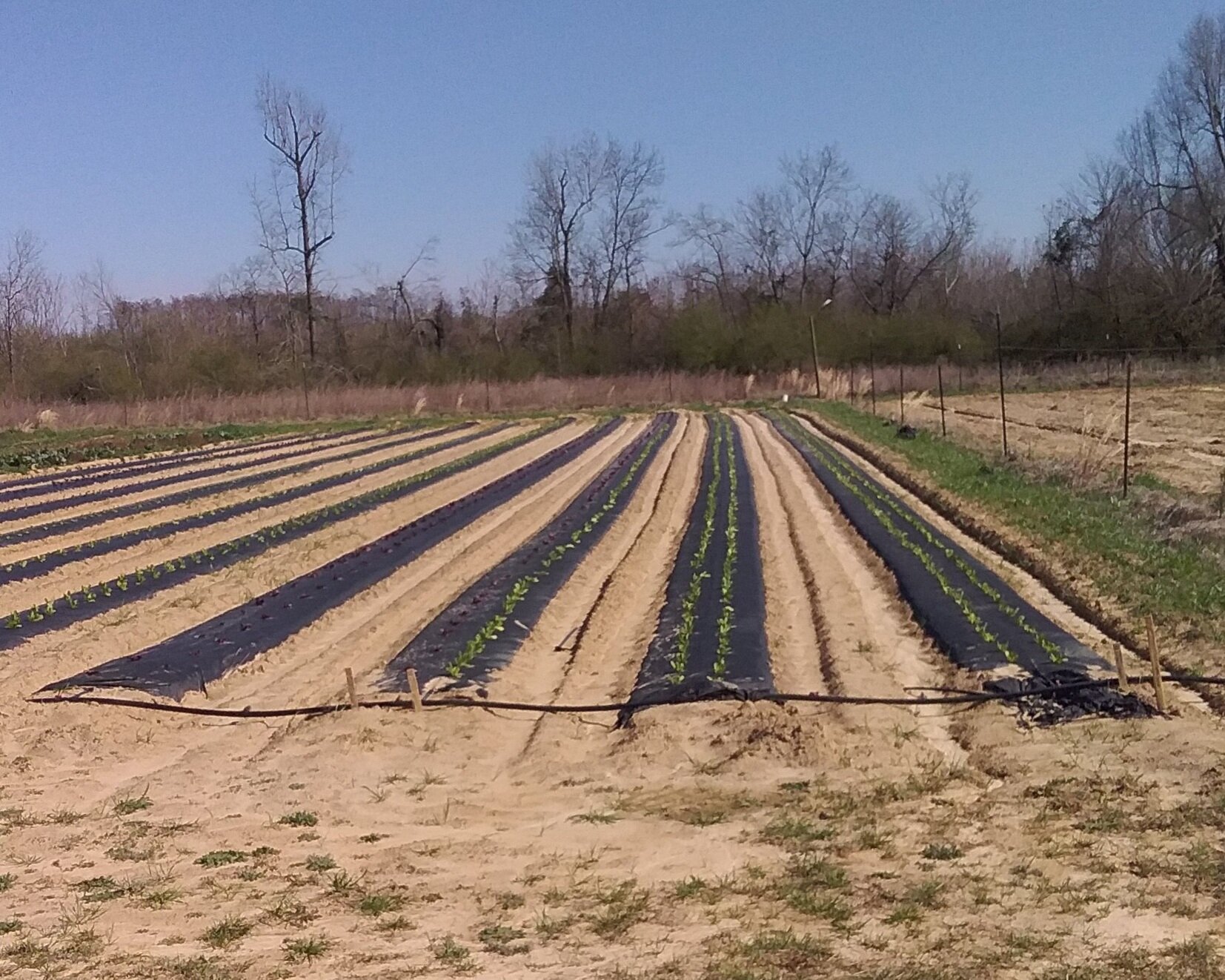
Mulch can be a great option for controlling your weeds while helping your soil moisture while also helping keep dirt off your picky plants (looking your way, tomatoes.) You can use plastic or paper mulch, which is available at your local hardware store. Alternatively, you could use good old fashion wood chips or pine straw.

What to plant?

Love is Love starter plants. Photo by Caroline Croland.

Love is Love starter plants. Photo by Caroline Croland.

The question boils down to a simple determination- what would you like to eat or provide for your neighbors and community? What are your intentions and objectives for your garden? Do you want to grow herbs or edible flowers that you can pick nightly to accentuate your meals? Are you going to be drying and preserving herbs or vegetables? Some crops can grow prolifically in a small space, so having an idea of your objectives will help inform your plan of how much to grow. 

Again, utilize your notes here to track your progress so you can adjust your planting plans each year.

Please note that spring in the Atlanta area tends to be relatively short, so some things you plant in spring won't last as long as your summer crops. However, all of these crops do have to be planted at the same time. Make a note when planning your garden that you will be turning the space where you grow spring items over more quickly than your summer crops.

Are you stumped on where to start? Here are some suggestions from Joe:

  • Cherry tomatoes

  • Arugula

  • Radishes

  • Turnips

  • Bush beans

  • Peppers

  • Edible herbs and flowers

These can be planted directly from seed or by purchasing starter plants from your local farmer. Click here to access Love is Love's plant sale or search the Plant Sale tag on our Good Food Guide to purchase from a farmer near you!

In addition to Joe and Demetrius teaching us to plan our garden, Laura provided a demonstration on how to involve your kids in gardening. Check out this resource from Foodcorps on creating Seed Tape to replicate that activity at home.

Planning a garden can be daunting, but by taking some thoughtful planning steps, you will be well on your way to growing your food.

Happy planting, ya'll!


Visit gfft.georgiaorganics.org/virtual-events to view upcoming GFFT events and register. 

Stay connected to Georgia Organics! If you are not yet a member, you can join at membership.georgiaorganics.org/!

Buy your starter plants from local farms by searching the “Plant Sale” tags in our Good Food Guide

Learn more about Love is Love Farm: loveislovefarm.com and check out their plant sale!

Check out Love is Love’s General Growing Guide for additional tips!

Meet Organic Ag and Farm to School Hero, Loretta “The Farmer” Adderson

By Kimberly Koogler

Kimberly Koogler is the Farm to School Coordinator at Georgia Organics. To learn more about Georgia Organics, visit www.georgiaorganics.org and follow us on Instagram @GeorgiaOrganicsTwitter @GeorgiaOrganics, and at www.Facebook.com/GeorgiaOrganics. 

Photos courtesy of Loretta Adderson.

Photos courtesy of Loretta Adderson.

To celebrate Women’s History Month and women in agriculture, we’d like to highlight the contributions to organic agriculture and Farm to School in Georgia by a trail-blazing woman, Georgia farmer, and newly-elected Georgia Organics board member, Loretta Adderson. 

Loretta and her husband Samuel Adderson, recipients of the 2018 Georgia Organics Land Stewardship Award, are third-generation family farmers with over 70 years of growing experience. They have been farming together for 14 years in Keysville, GA, where they are pioneers in organic agriculture and have served as mentors to many other aspiring organic farmers in the area. Their farm was the first to be USDA-certified organic in the Central Savannah River Area in 2011. Loretta grew up on her family’s farm with six brothers. 

This photo of Loretta on a tractor was taken over 50 years ago on her family’s farm. She says, “At this time, I was in College and enjoying being home with my family. In the 1960s, girls weren't encouraged to become farmers, but I always loved being…

This photo of Loretta on a tractor was taken over 50 years ago on her family’s farm. She says, “At this time, I was in College and enjoying being home with my family. In the 1960s, girls weren't encouraged to become farmers, but I always loved being outdoors.” 

 After retiring in 2006 from Public School Nutrition work and working and living in Pennsylvania and Michigan, she and her husband returned to the family farm in Georgia, where they started farming together. The name of their business is Adderson’s Fresh Produce, and they grow a diverse array of vegetables, fruits, and herbs. 

I asked Mrs. Adderson a few questions to get to know her a little more and to see why she farms and what inspires her. She generously took the time to answer all my questions, even as Spring fast approaches and her work on the farm becomes more demanding.

Photos courtesy of Loretta Adderson.

Photos courtesy of Loretta Adderson.

 How did you learn how to grow food?

I’m convinced that it’s in my DNA and many years of working on the farm. Penn State, Michigan State, Ala A & M, UGA and FVSU Extension Services, and many other workshops. 

My husband and I lived in Carlisle, PA, State College, PA, Allison Park, PA, Warner Robins, GA, and Lake Orion, MI, before retiring back in Georgia. Everywhere we lived, I had a garden and was known as the Farmer. I'm just beginning to connect the dots to my love for farming.  

Why do you farm organically?

On our farm when I was growing up daddy never put any chemicals on the garden area. They put the manure down at the end of the year for the next planting season. It was never called organic, so I knew we had to grow without using harmful inputs. Healthy soil yields healthy food, which equals healthy body. Grow Organic for Life.

What is your ultimate mission in farming? Why do you do what you do?

My ultimate mission in farming is to provide the next generation with safe land to pursue their dreams. I envision a farm with drones and robotic tools and equipment. Indoor growing at levels we never thought of. My dad wanted the land to be here for generations to come, and I do too.

What does “farm to school” mean to you?

“Farm to School” means the Farmer/Farm working directly with the school/nutrition program to enhance their school programs.

How do you participate in your local school system’s farm to school program, and why do you?

Adderson’s Fresh Produce has sponsored tours of the fields, orchard, and hoop house for School Nutrition Employees that included lunch prepared on the farm using farm-grown, organic vegetables. We’ve participated in on-campus Field Days and enjoyed lunch with the students. We’ve sold produce to the School Nutrition Program. We assisted the School Nutrition Program with starting a Farmers Market and participated as often as possible. We do this to help the students learn more about where food comes from, to expose the students to locally grown, fresh vegetables, and see the farmer who grew those vegetables.

Do you think farm to school programs have the potential to cultivate future organic farmers like yourself?

I definitely do; I feel by 2030, we will see a drastic increase in Organic Farms and Farmers. Schools are going to add farming to their curriculum as an elective and as a requirement by 2050.

What is one thing you would like to tell young people about farming?

Learn to grow food!

What is one thing you would like to tell young girls and women about farming?

Farming is a business that connects you to nature and the soil. 

Who is a woman you have looked up to and who has inspired you?

My great-great Grandmother, Tempe Jackson, was a farm owner and was driven off during the “Trails of Tears." My great-grandpa lived with us after he was older and would tell us about her and how he worked with her on the Farm. My mom and dad named my sister, who died as an infant before I was born, "Shirley Tempe," after my great-great-grandmother.

Our mom and dad brought their own farm and raised us on it. Farming in our family goes back to the 1860s. I am proud of our heritage.

It takes true grit, resilience, fortitude, and dedication to organically produce food from the earth, especially here in the South. On top of that, to go the extra mile and actively participate in her local school system’s farm to school program is a truly generous investment in our state’s future. It is not an easy job, but Loretta Adderson knows that it is as important as it is challenging. We are truly grateful for Mrs. Adderson and the legacy she is growing as she paves the way for future generations of organic farmers in Georgia.

You can find the Addersons’ organic produce at the Laney Walker Farmers Market, the Veggie Park Farmers Market, the Augusta Locally Grown Online Market and On-Farm Popup Markets.


Follow them on social media at facebook.com/addersonsfreshproduce.

Be sure to save the date for our 8th Georgia Farm to School and Early Care and Education Summit to be held virtually April 27- May 1! Learn more at bit.ly/2021SUMMIT

Good Food for Thought: Dish Dive into Wholesale and High-End Wholesale

By Kayla Williams 

Are you a farmer that sells to farmers’ markets or have a CSA but are ready to get into the wholesale market, either to restaurants or institutions? Luckily, we have some tips for you! On Thursday, February 26th, Lauren Cox, Organic Procurement Coordinator at Georgia Organics along with Zac Harrison, owner of Fresh Harvest, and Neil Ringer, Director of Operations of The Common Market Southeast shared knowledge on what the processes look like to enter the wholesale market in Georgia in a variety of ways. Previously, Lauren managed Woodland Gardens, an organic mixed vegetable farm in the Athens-area that sells to many restaurants in Atlanta and Athens. At Georgia Organics, Lauren works  closely with farmers to help them sell to  larger institutions and restaurants, from helping them crop plan to organizing QuickBook trainings, improving their marketing skills and more. Lauren shared her knowledge about some pros and cons of selling to restaurants and larger wholesale markets in general, as well as best practices – we’ll share some here.

Whichever way you decide to “slice your pie”, your farm will become more resilient if you have multiple revenue streams. Maybe you attend one farmers’ market on the weekend, have CSA (community supported agriculture) pick up on Tuesdays, and deliver to restaurants in your closest larger city on Wednesdays. Or maybe, you sell to one large wholesale customer on Thursdays, delivery to restaurants on Fridays and do a CSA pick up on Saturdays, skipping farmers’ markets all together! You can choose how you slice your pie, but it’s important as you scale up, to add more revenue streams so you can be flexible as needed. So how do you choose?

Restaurant Walk-In. Photo credit: Bailey Garrot.

Restaurant Walk-In. Photo credit: Bailey Garrot.

Although restaurants can be unreliable customers due to frequent menu and staff changes, you can usually get the best wholesale price available and because you are harvesting to order, you won’t have any leftovers. If you decide to sell to a larger wholesale customer, like grocery stores or distributors, you may have to settle for the lowest price point for your goods (as compared to the retail farmers’ market price) but the transactions may be more reliable working with a larger institution, and they may come pick up the products from your farm rather than delivering to a restaurant. It’s important to remember that the type of operation you run may be a better fit for some wholesale than others – if you are small and very diversified farm, you may be a better fit for a high-priced restaurant that uses smaller quantities of many products. If you are larger and specialize in (let’s say) tomatoes, you may be a better fit for a local pizza joint that makes huge quantities of sauce daily

Quick Cleaning Turnips. Photo credit: Lauren Cox,

Quick Cleaning Turnips. Photo credit: Lauren Cox,

. No matter which revenue streams you choose, recordkeeping is essential. From knowing where things are in the field, to making sure you have a consistent inventory for your customers, to knowing the prices each item sells for through your various streams, to telling your employees where to harvest what, recordkeeping can only make your life easier and more organized. How you harvest, package and clean your products also make a difference in the world of wholesale. Minimize handling your products because the more you touch it, the more degraded it gets,  especially when wholesalers are aggregating, repackaging and redistributing. Cleanliness is key and minimizing moisture in washed greens, for example, extend the shelf life of your produce.

The Common Market, a non-profit aggregator and distributor, works with many institutions such as private schools, hospitals, universities, food service providers and municipal offices. The Common Market Southeast Headquarters are in East Point, GA but they also have a program based in Houston, TX and Philadelphia, PA. The Common Market wants to lower barriers and provide the infrastructure for local farmers to be able to sell to these institutions. The requirements for working with The Common Market Southeast are as follows: farmer must be in a 250 mile radius of their offices, must have sustainable growing practices, proof of liability insurance, be involved in a food safety program, and have a post-harvesting handling and packing system. Additionally, you must pack your products in wax boxes with your contact information on the label. During COVID-19, The Common Market Southeast received a USDA grant that allowed them to deliver over 96,440 boxes to families across the state, partnering with over 45 community organizations and purchasing over 964,000 pounds of local food purchased and distributed. Their systems and infrastructure made that work possible. A big thanks to Neil Ringer and Common Market for sharing with us and doing incredible work every day to make it easier for local producers to be involved in larger institutions!

West Georgia Farmers Coorperative Delivering to Miller Union. Photo Credit: Bailey Garrot.

West Georgia Farmers Coorperative Delivering to Miller Union. Photo Credit: Bailey Garrot.

Fresh Harvest, on the other hand, is solely residential. Each week, Zac Harrison texts all the farmers in the Fresh Harvest network (some big, some small, but all organic) and finds out what their availability is for the week. Based on which farmer has what products, he compiles weekly boxes that are delivered to homes around Atlanta. In addition to a weekly produce box, customers can add on other local goods, like local dairy, eggs, meat, prepared foods and more. Fresh Harvest’s offices are in Clarkston, GA and they employee many refugees that are based in Clarkston. Zac’s goal is to expand the reach and sale of the farmer, not to infringe on their other revenue streams and he wants to crop plan with farmers at the beginning of the season, so they can be guaranteed a revenue stream from Fresh Harvest.

No matter which route you decide to go down for slicing your pie, utilizing the tips from Lauren and working with folks like Neil and Zac who have the farmers’ best interest at heart, choosing to diversify your revenue streams can only make your farm more successful and resilient.


Interested in learning more about Lauren’s work? Check out farmtorestaurant.georgiaorganics.org/, follow Georgia Organics on Instagram @georgiaorganics, and Facebook at facebook.com/GeorgiaOrganics/.

Want to see if The Common Market may be a good fit for you or support their work? Check out thecommonmarket.org, follow them on Instagram at @commonmarketse and Facebook at facebook.com/thecommonmarketse.

Ready to work with Fresh Harvest or purchase a box? Visit them at freshharvestga.com/, follow them on Instagram at @freshharvest and Facebook at .facebook.com/freshharvestga.

Good Food for Thought: How We Slice Our Pie—Choosing Markets and Managing Revenue Streams

By Lauren Cox 

Lauren Cox is the Organic Procurement Coordinator at Georgia Organics

Aluma Farm’s very organized harvest board. Photo credit: Bailey Garrot.

Aluma Farm’s very organized harvest board. Photo credit: Bailey Garrot.

Small farms operate much like other small entrepreneurial businesses. In addition to producing food, a farmer must also be a self-promoter, a marketer, their own research and development team, and very often juggle the wants and needs of a variety of customers. In the 6th installation of the Winter Webinar series, Farm to Restaurant’s Organic Procurement Coordinator leads a three-part webinar covering these activities: deciding on your basket of goods and services and creating a value statement, managing your weekly farm flow, and understanding how you divide up your farm based on your revenue streams.  

Whether you sell at the farmers market, to restaurants, wholesalers, or through a CSA program, you should aim to know your customer base and plan for moving product. Photo by Lauren Cox.

Whether you sell at the farmers market, to restaurants, wholesalers, or through a CSA program, you should aim to know your customer base and plan for moving product. Photo by Lauren Cox.

There are multiple ways for farmers to get food to their final customers. This ‘farmer to eater’ supply chain can include processors, wholesalers, restaurants, grocery stores, and retailers or simply go directly into the hands of an eater. Farmers can sell to each of these groups and should understand that each one of them has different wants and needs, including where they hold value and what they are looking for when buying from a farmer. 

This ‘basket of goods and services’ can also change over time depending on the farmer as well as the customer. While planning for the year ahead, ask yourself: What am I selling and why is it important to my customer? Remember, what is important to you isn’t necessarily going to be important to everyone else. Maybe your customer values being able to talk to you each week and ask questions about what they’re buying while you prioritize paying your employees fair wages and growing organically. One does not necessarily exclude the other but again, your customer’s values and where they’re prioritized might not be the same as your own. 

Thinking about a value statement or value proposition is also important. This can change with your customers and correlates to your basket of goods and services. If you can’t make money from your basket of ‘goods and services’ then don’t do it and always make sure you have a feedback loop to understand if your customer’s values are changing. Easy ways to do this include talking to your customers directly as well as conducting surveys to market-goers and CSA members. Also watching what sells quickly and what doesn’t is a non-verbal way to assess your markets. No matter what, having a feedback loop gives a farmer the advantage to help plan for growing any of their revenue streams. 

Planning for growth is important. Photo by Lauren Cox.

Planning for growth is important. Photo by Lauren Cox.

As you think about the year ahead and decide which customers and parts of your business will shift or grow, consider your current weekly farm schedule. Taking on more revenue streams could mean you take more time off the farm for market days. It could mean more time spent harvesting and delivering to wholesalers or restaurants. While planning, try this exercise: Make a column for each day of the week and then fill it with the general tasks you do consistently, for example, Monday’s are bookkeeping days, and Tuesday, Wednesday, and Thursday are workdays while Friday is a harvest day for Saturday market. Once this is done ask yourself, “Does my weekly flow feel well-paced? Is it packed in one part of the week and less busy in another? What if there were an emergency? Do I have enough time, in that case, to react? And finally, “Could I take on another sales channel?” Depending on your customer’s needs and values, you might be able to shift your schedule to take on new opportunities or give you that much-needed time on the farm you’ve been looking for.  

 Listing out your top sellers across your different markets can highlight your resiliency in withstands shifts in market demand. Photo by Lauren Cox.

 Listing out your top sellers across your different markets can highlight your resiliency in withstands shifts in market demand. Photo by Lauren Cox.

How do we bring what we know about our customer base, our weekly bandwidth, and how we want to grow our business together to refine our systems and plan for the year ahead? First and foremost record-keeping is our biggest asset! Thinking about your ‘top sellers’ for each customer base and looking at your books to see if you’re making money on them can give you valuable insight (no pun intended) into whether or not you’re on the right track. Ideally, you should plan for growth and have multiple customers that are interested in the same thing in case one of them falls through. In addition to QuickBooks and surveys, keep a notebook with your weekly sales information. Walk around the first day of your workweek and write down what you need to sell, how much you have, and to whom you plan to sell it to (CSA, restaurants, markets, or otherwise).

This exercise will help you get better at understanding quantities of what you have to offer and how much space you are allocating on your farm for each sales outlet. As you think about the space on your farm and how it relates to your customer base ask yourself these questions: What isn’t selling to multiple customers? Are there other things I could use that farm space for? Are there other things I could sell to the same customers that also sell at other markets? Asking yourself these questions explicitly with give you a leg up in planning for growth and managing your revenue streams. 

This Good Food for Thought event was a workshop exclusive to Georgia Organics Farmer Members. Interested in becoming a farmer member for just $12 per year? Visit membership.georgiaorganics.org/farmer-membership. Join us for more Good Food for Thought by visiting gfft.georgiaorganics.org/virtual-events.

Good Food for Thought: Working Together—Cooperative Agriculture & Harnessing the Power of the Collective

By Kayla Williams

Kayla Williams is a Farmer Services Coordinator at Georgia Organics.

On February 17, the Good Food for Thought and Farmer Services team brought together many key players in the cooperative food world of Georgia. Eric Simpson of the West Georgia Farmers’ Cooperative, Terence Courtney of the Federation of Southern Cooperatives, Matthew Epperson of the Georgia Cooperative Development Center and Ahzjah Simons of the Sevananda Natural Foods Market presented on their respective works and then held a fruitful conversation about all things cooperatives from federal policies that support (and don’t support) cooperatives, how individuals can support cooperative businesses and the ways in which community is centered in the cooperative models’ by laws. Luckily, this webinar was recorded and available for you to watch!

You can connect with participants in this virtual event below…

Join us for future Good Food for Thought sessions! Upcoming dates and registration links at gfft.georgiaorganics.org/virtual-events.

Good Food for Thought: Culture and Connections—Farmer Organizing the SAAFON Way

By Kayla Williams

Kayla Williams is a Farmer Services Coordinator at Georgia Organics.

In this series, we’re revisiting our most recent Good Food for Thought conversations. To register for Georgia Organics’ upcoming Good Food for Thought events, visit gfft.georgiaorganics.org/virtual-events.

On February 10, the Southeastern African American Organic Farmers’ Network (SAAFON) partnered with Georgia Organics for a Good Food for Thought Webinar. Dr. Jahi Chappell, the new Executive Director of SAAFON, along with Tammy Harris, the Agroecology & Education Resource Coordinator. SAAFON focuses on supporting black farmers in the southeast, with member affiliates from Maryland to the US Virgin Islands, through direct services, community building and resource sharing.

Dr. Chappell shared his background in the world of sustainable agriculture that led him to SAAFON, the organizations’ values and its history. Tammy shared the ways in which those values are implemented into SAAFON’s programmatic work and more about specific initiatives they are currently working on.

I’m not going to spend time summarizing the content of the webinar, because it would be doing Dr. Chappell and Tammy Harris a disservice to the knowledge they shared about SAAFON. Instead, you’re encouraged to watch the recorded webinar, click below!


Want to learn more about SAAFON’s programming or become a member? Visit saafon.org, follow on Instagram @saafon_grows, and on Facebook at facebook.com/SAAFONgrows Want to support SAAFON’s work? Donate at saafon.org/donate.

Join us for upcoming Good Food for Thought sessions in our Winter Webinar series for farmers! Upcoming dates and registration links at gfft.georgiaorganics.org/virtual-events.

Good Food for Thought: Continuing Towards Deep Sustainability

By Porter Mitchell

Porter Mitchell is a Farmer Services Coordinator at Georgia Organics.

In this series, we’re revisiting our most recent Good Food for Thought conversation Continuing Towards Deep Sustainability led by Mark Cain of Dripping Springs Garden. To register for Georgia Organics’ upcoming Good Food for Thought events, visit gfft.georgiaorganics.org/virtual-events.

Mark Cain (front) and partner Michael Crane (behind) tend tulips Courtesy Beth Hall Photography.

Mark Cain (front) and partner Michael Crane (behind) tend tulips Courtesy Beth Hall Photography.

Mark Cain and his partner Mike Crane chose the property for the creek. It was 1984 and the young couple wanted to reconnect with the land and begin their own farm. Like so many young farmers that came before them and like so many that would come after, they left the city and settled in a rural nook of the country to live out their dream of having their own farm.

Dry Fork Creek weaves through the back of the seven-acre property, located in a small valley nestled in the spectacular beauty of the Arkansas Ozarks.

“Mike and I used to set up a hammock by the creek on warm afternoons,” remembers Mark. It was one of the most special parts of their new lives as farmers. They would walk down to the creek together and relax in the hammock, enjoying the beauty and peace of their surroundings.

Creek Courtesy of Dripping Springs Garden.

Creek Courtesy of Dripping Springs Garden.

But slowly the afternoons in the hammock became less and less frequent, and then they stopped altogether. There is endless work on a farm and no spare moments for laying in hammocks. There is irrigation to lay, tractors to fix, storms to recover from. There are hundreds of feet of onions to plant, thousands of pounds of greens to wash, and farmers market days that begin at three in the morning. “There’s no end to the work,” notes Mark. “You have to work incredibly hard to even earn a modest living.”

Photo Courtesy Dripping Springs Garden.

Photo Courtesy Dripping Springs Garden.

A few years went by. The farm was successful and growing a loyal customer base. But the work didn’t get any easier. A friend came to visit the farm and Mark took her on a tour of the property. They came to the creek. Mark explained how he and Mike used to love spending afternoons together in the hammock and how special the creek was to them. “When’s the last time you did that?” the friend asked. Mark couldn’t remember. It had been years.

Mark couldn’t stop thinking about the interaction. The very reason he and Mike began farming—to connect with the natural world and spend more time together—was totally lost in the farm’s whirlwind of constant work and stress.

He couldn’t keep going like this anymore. He was putting off enjoying his life—his hobbies, his friends, his interests—his whole life was consumed by the farm.

And he was getting older too. There wasn’t endless time to finally get around to enjoying himself.

“You don’t want to die wishing you had experienced all of these aspects of life,” reflects Mark. “How can we take time to enjoy what's important to you and still build up the farm?”

He realized that for his farm to be sustainable—to last and keep going—he needed to take care of himself. There is no sustainable farm without a happy and healthy farmer.

Mark began to change his relationship to work. He began to focus on training others and delegating so less was on his shoulders. He instituted a new farm schedule with a mid-afternoon yoga break to care for his (and his staff’s) minds and bodies. He began to focus on ease of movement in his work to put less strain on his body. He devoted himself to following routines, creating rhythms at the farm, and staying organized to reduce stress. He began practicing mindfulness to ground himself in the present and enjoy a cool breeze or the beautiful color of a flower instead of worrying about the work. And he created time for the rest of his life.

Dripping Springs Garden staff, photo courtesy of Dripping Springs Garden.

Dripping Springs Garden staff, photo courtesy of Dripping Springs Garden.

“We need to set boundaries around what’s important to us so the farm doesn’t eat all of it,” explains Mark. Farmers are not just farmers—they are people with hobbies, interests, friends, and families. Mark stresses how important it is to a farmer’s health and wellbeing to take time for activities outside of farming. 

“Your attention is a precious resource and we need to use it wisely. Remember what makes you feel good—spending time with your kids, taking a walk, playing guitar—these things can be worked into your schedule,” encourages Mark. 

“Farming is a big hog that will gobble up all of your time, so you need to build a fence around the things that are important to you and protect it.”

And take time to remember why you began it all in the first place.

“This is it! This is farming. Farming is beautiful harvests and a mountain of work that’s never done. Come to terms with that to learn how to enjoy what’s happening now.”

Check out the full recording of Mark Cain’s talk here: Continuing Towards Deep Sustainability


Learn more about Mark Cain and Dripping Springs at drippingspringsgarden.com/our-story

And check out regular tips from Mark Cain on our farmer newsletter, Grower News! Click below.

Reflections on Employee Management and Retention with Hearts of Harvest Farm 

By Kayla Williams 

Kayla Williams is a Farmer Services Coordinator at Georgia Organics.

Aluma Farm staff harvesting together. Photo credit Bailey Garrot. (photo taken pre-pandemic)

Aluma Farm staff harvesting together. Photo credit Bailey Garrot. (photo taken pre-pandemic)

Running a farm business requires more than just an ability to grow food. If you want to create a business that requires employees, you suddenly jump into managing people, payroll, and human resources. Managing employees can be overwhelming, from training people to fit into your systems to fitting them into the social fabric of your farm. Paul and Lindsey Sorah along with Mark Golden, co-owners/operators of Hearts of Harvest farm in Arnoldsville, GA, have prioritized employee management over the past three years of running their mixed fruit & vegetable, cut flower and mushroom operation.

Paul and Lindsey Sorah of Hearts of Harvest Farm. Courtesy of Hearts of Harvest Farm.

Paul and Lindsey Sorah of Hearts of Harvest Farm. Courtesy of Hearts of Harvest Farm.

On Wednesday February 3, Paul shared some of his best practices for employee management and retention on a Good Food For Thought webinar.  

The conversation focused on the importance of communicating with your employees – not only do folks have different learning styles and may need to be given directions through multiple different mediums. For example, if you are trying to train three employees on how to wash and pack for market, one may synthesize that information best through demonstration, another may want the process to be written down, and someone else may appreciate being told through conversation.

Giving context to why you are doing what you are doing also can help folks process and internalize material. Paul begins each morning with tasks for the day written on the whiteboard, so all of the employees are on the same page about what the plans are – giving folks their tasks in advance rather than one at a time both allows the employees to manage their time and feel a sense of investment in the day. He has regular check ins with his staff – making sure they know that they can feel comfortable and empowered to give him feedback and lets them know that he cares about their experience working for him.  

Mark Golden of Hearts of Harvest Farm harvesting broccoli.  Photo credit Bailey Garrot. (photo taken pre-pandemic)

Mark Golden of Hearts of Harvest Farm harvesting broccoli. Photo credit Bailey Garrot. (photo taken pre-pandemic)

When looking for employees, Paul emphasizes that “good vibes” is just as if not more important than having a lot of farm experience. Farming is an incredibly intimate job – from long hard days to deep conversations in the field, you want your employees to mesh with each other and with you. Hearts of Harvest gives new hires a 30-day trial period to figure out if they are a good fit – most folks have ended up staying, but some new hires spend two weeks and realize it’s not working for them.

Paul also recommended some “low to no cost morale boosters” regularly expressing gratitude for staff, hosting regular team potlucks, buying staff lunch on a particularly hard day, giving birthday cards. His staff also gets paid time off and flexibility around the holidays.  

It’s all of these practices and more that encourages Heart of Harvests’ employees to come back for multiple seasons.  


To support Hearts of Harvest Farm visit their website here, and follow them on Instagram @heartsofharvestfarm and at www.facebook.com/heartsofharvestfarm

Our Good Food for Thought Winter Webinar for farmers series continues, learn more and register at gfft.georgiaorganics.org/virtual-events.

The Rise and Fall of ‘Farm to Table’ and through it all, our Farmer Champions

By Lauren Cox

Lauren Cox leads Georgia Organics’ Farm to Restaurant and Farmer Champion campaigns as Organic Procurement Coordinator at Georgia Organics. She is also a former farmer.

Blazer of Farmer Champion Gunshow. Photo credit: Bailey Garrot. (photo taken pre-pandemic)

Blazer of Farmer Champion Gunshow. Photo credit: Bailey Garrot. (photo taken pre-pandemic)

Farm to Table restaurant dining has had its ups and downs as popularity goes. From becoming a hallmark of California cuisine in the 1970s to reaching its zenith and broader accessibility in the early 2000s, the farm to table narrative of freshly cut greens brought in from bucolic fields to clean kitchens and hip restaurants was all the rage. Chalkboards went up, farm names were thrown around, and eaters felt empowered in thinking they knew where their money went.

Then, sadly, came greenwashing. Fad started to come before fact and some restaurants who said they were farm to table -but really weren’t- got called out.* The resulting sour taste left in everyone’s mouth, from restaurant clients to chefs and restaurateurs themselves, has unfortunately endured, in some form or fashion, to today- the street cred of publicly labeling oneself ‘farm to table’ all but vanished.    

Nowadays, when you see locally-sourced food at restaurants, it’s often quietly tucked into the menu rather than spotlighted for all to see. A discerning eye may notice a pickled summer vegetable accompanying a main dish, a cured meat and local cheese board, and almost always the telltale ever-changing daily menu. The chefs and restaurants who sourced from these farms, foragers, and artisanal cheese makers back in the day have continued to do so despite the lack of faith and marketability ‘farm to table’ now holds The challenge now, however,  with being less vocal about this sourcing is that it’s even harder for local-food-loving customers to find out where to go.

For those who may not know, truth is, there are many flavors of ‘farm to table’. Some restaurants will choose to support farmers through seasonal, ‘one-off’ purchasing. Take, for example, the neighborhood pizzeria that only changes its menu, once a year, for tomatoes. Then there are highly visible, highly marketable, pre-pandemic farm to table dinners featuring a prix-fixe ‘journey’ through a local farm’s walk-in cooler, steep price point, and the always exciting chance to eat dinner seated next to an honest to goodness, dirt under the nails, Canadian tuxedo-wearing farmer. There are those fundraising events that ham up chef-farm partnerships and even those restaurants that find themselves having crossed over into the farmer world through rotating chef demos and food tents at a local weekly market.

Nathan Brett of DaySpring Farms and Chris Wilkins of Farmer Champion Root Baking Co. Photo credit: Bailey Garrot. (photo taken pre-pandemic)

Nathan Brett of DaySpring Farms and Chris Wilkins of Farmer Champion Root Baking Co. Photo credit: Bailey Garrot. (photo taken pre-pandemic)

All these  examples are valid ways for restaurants to support the local food movement , but if you were to ask a farmer where it counts, they’ll likely tell you that it’s those restaurants that buy from them week to week and month over month, that truly represent the farm to table ethos. 

Quite often, the weekly flow for a farm to restaurant sourcing relationship looks something like this: The farmer walks out to their field on Monday morning and checks what’s ready for harvest. They then send a list of what’s available to whoever leads weekly ordering at the restaurant; often this is done directly with the executive chef, their chef de cuisine, or sous chef. Within a 24-hour window, the farmer receives the restaurant’s order and harvesting begins. One day passes then the farmer pulls fresh produce, meat, grain, etc. from a post-harvest temporary home, loads everything into a van, and makes the drive to deliver. Sounds pretty straight forward right? Well, not exactly. 

West Georgia Farmers Cooperative farmer dropping weekly orders at Miller Union. Photo credit: Bailey Garrot. (photo taken pre-pandemic).

West Georgia Farmers Cooperative farmer dropping weekly orders at Miller Union. Photo credit: Bailey Garrot. (photo taken pre-pandemic).

Many factors determine what a successful (and therefore long-lived) farm to restaurant relationship looks like. First off, does the price point work for the farmer AND the chef, and is the farmer growing something the chef wants? What about a chef that is unwilling to work with different products in place of an ingredient they originally planned for? Let’s be honest, folks, some things just don’t grow well in Georgia.

And what about supply? Some farmers may not individually have enough of one thing to supply a high-volume restaurant so is the effort in training and retraining the kitchen to switch dishes and the servers to remember the substitutes even worth it? Where is that farmer who sells unripe, green strawberries anyway?? And most importantly, will people show up to eat at these restaurants or order take out in the middle of a pandemic? 

Chipping away at the mythical meaning of ‘farm to restaurant’ is valuable so that eaters can support restaurants that support farmers if they so choose. Having the knowledge to make thoughtful dining choices is more important than ever, as we’ve seen restaurants both big and small, locally owned and corporate alike, forced to permanently close their doors during the pandemic.

The takeaway is that without a doubt, where you spend your money as a consumer counts. 

Aluma Farm owners Andy Friedberg and Andrea Ness with Chef Terry Koval of Farmer Champion The Deer and The Dove. Photo credit: Bailey Garrot. (photo taken pre-pandemic)

Aluma Farm owners Andy Friedberg and Andrea Ness with Chef Terry Koval of Farmer Champion The Deer and The Dove. Photo credit: Bailey Garrot. (photo taken pre-pandemic)

In 2019 Georgia Organics created the Farmer Champion campaign based on hearing from chefs and farmers what it looks like when restaurants source locally, day in and day out. Many of the aforementioned questions came up, but none of them deterred the restaurants that were committed to their Georgia farmers. Weekly purchasing of local products and these conversations helped inform the creation of a tiered, quantifiable scoring system based on the percentage of a restaurant’s total food costs going towards in-state and Certified Organic producers. Learn more about this system and our Farm to Restaurant program at farmtorestaurant.georgiaorganics.org/.

To date, 20 restaurants are part of this campaign, hailing from Atlanta, Athens, and Macon with their contact info listed on the Restaurants page of Georgia Organics’ Good Food Guide at gfg.georgiaorganics.org/restaurants.

In the realm of ‘farm to restaurant’, there is no doubt that relationships reign supreme so as you think about where to eat, consider supporting these connections and what they mean by eating with our Farmer Champions.


Find Farmer Champions near you on the Restaurants page of The Good Food Guide at gfg.georgiaorganics.org/restaurants

Learn more about the Farm to Restaurant program at farmtorestaurant.georgiaorganics.org/

*In 2016 the Tampa Bay Times released an investigative article titled Farm To Fable, that exposed instances of green-washing by popular Tampa Bay restaurants. Georgia Organics’ Farmer Champion campaign seeks to create transparency in sourcing and be a resource for eaters who are interested in supporting chefs and restaurants that buy from Georgia farmers while the Farm to Restaurant program works with Georgia farm to help them become restaurant ready. 

Good Food for Thought: Accessing NRCS Programs for Your Livestock Operation 

By Kayla Williams 

Looking to create a rotational grazing plan or add fencing to your pastured cattle operation? Improve your water quality by creating stream barriers to prevent your pigs from getting into the water? The NRCS (Natural Resources Conservation Service) is here to help! On Wednesday January 27, Good Food for Thought hosted a webinar featuring Bryan Hager of Crager Hager Farm, Ricky Dollison of Dollison Farms, and Jose Pagan from the NRCS to share resources and advice on accessing NRCS support for livestock operations. The NRCS is not a regulatory agency, and they work with private landowners on a voluntary basis.  

After verifying that you are registered with the FSA (Farm Service Agency), an NRCS agent from your region will help you first create a map of your property and then, a conservation plan based on your land and needs from land use on specific fields to soils maps. 

The NRCS has soil scientists, biologists, grazing land specialists, engineers and more, all to help you evaluate your land and create a conservation plan that works for your operation, so we encourage you to be expansive in the questions that you ask NRCS–you may be surprised with what they can help you with.  

From planting trees and shrubs along streams to watering facilities for your livestock to forage planting and creating a rotational grazing plan, there are many projects that the NRCS can assist you with. The majority of these NRCS conservation programs are funded by EQIP (Environmental Quality Incentives Program)

To incentivize and support these conservation projects, the NRCS will reimburse you based on the volume of activity like acreage of field seeded, linear feet of fencing installed or number of watering stations. They do have advanced reimbursement funding available for folks from underserved communities, so it doesn’t hurt to ask if that’s applicable to you!

Ask your NRCS representative about “Land Conservation Initiatives” – they have special pools of funding for specific projects they are working on, like establishing long leaf pines and protecting gopher tortoise populations in South Georgia.   

Ready to contact your local NRCS office? Here are some tips to keep in mind! 

Not all projects will be funded, and the most funding is available at the beginning of the federal government’s fiscal year in early October, so keep that in mind when you are planning when to begin the process with NRCS. If you’re hoping to build a barn, purchase equipment or build perimeter fencing with funds from the NRCS, think again. Their role is to support existing farm businesses, not to put your business into initial operation. 

When you sign a contract, they set aside funds to reimburse you for, so don’t sign up for more projects than you can realistically implement! Be sure to keep records of everything relating to the project. You are expected to complete the contract in two years and when you do complete your contract, contact NRCS to receive your payment.


Join us for upcoming Good Food for Thought sessions in our Winter Webinar series for farmers! Upcoming dates and registration links at gfft.georgiaorganics.org/virtual-events.


Kayla Williams is a Farmer Services Coordinator at Georgia Organics. To learn more about Georgia Organics, visit www.georgiaorganics.org and follow us on Instagram @GeorgiaOrganics, Twitter @GeorgiaOrganics, and at www.Facebook.com/GeorgiaOrganics.