Learning Beyond the Classroom: Fulton County School Nutrition Celebrates Black History Month

Kimberly Della Donna in conversation with Denielle Saitta

Kimberly Della Donna is the Farm to School Director at Georgia Organics. Denielle Saitta is the Project Manager of Marketing & Communications for Fulton County School Nutrition Program.


Denielle Saitta, the Fulton County School Nutrition Program Project Manager of Marketing and Communications, is affectionately known by her team as “the School Nutrition Cheerleader.” She is part of an entire team that loves to celebrate. In addition to providing nutritious breakfast and lunch daily to over 96,000 students, Café Managers implement seven marketing promotions each school year that incorporate nutrition education, special holidays, and school-sponsored events. 
blackhistorymonth.jpg

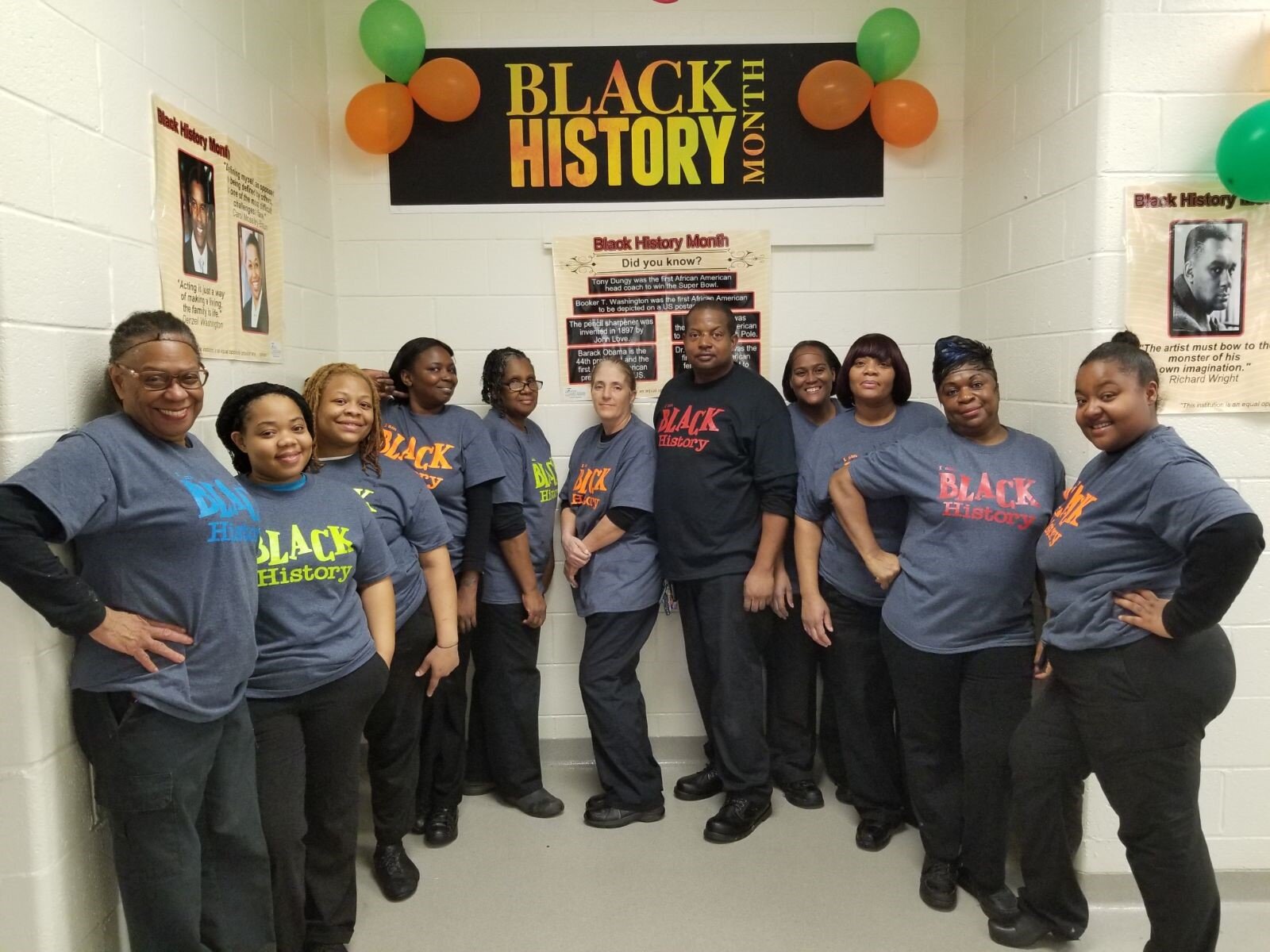
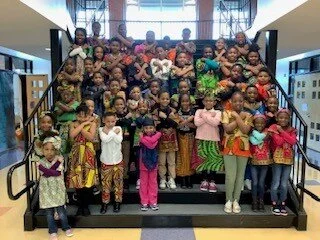
Each month Fulton cafes recognize a different cultural cuisine to explore nutrition, culture, and culinary traditions while marketing the offerings of their menus. This initiative celebrates the many cultural backgrounds that make up Fulton County Schools’ students, teachers, and staff. This month they are celebrating Black History Month, honoring black culture and remembering those who have made great strides throughout history. 

Denielle sees the month-long celebration as an educational opportunity to fill in the gaps not found in textbooks or classrooms. “By exploring different heritages and cuisines, we honor and celebrate different cultures. From something as simple as an ice cream scoop or as commonplace as refrigerated trucking, African Americans have always been vital creators and inventors and have helped shape food industries.” 
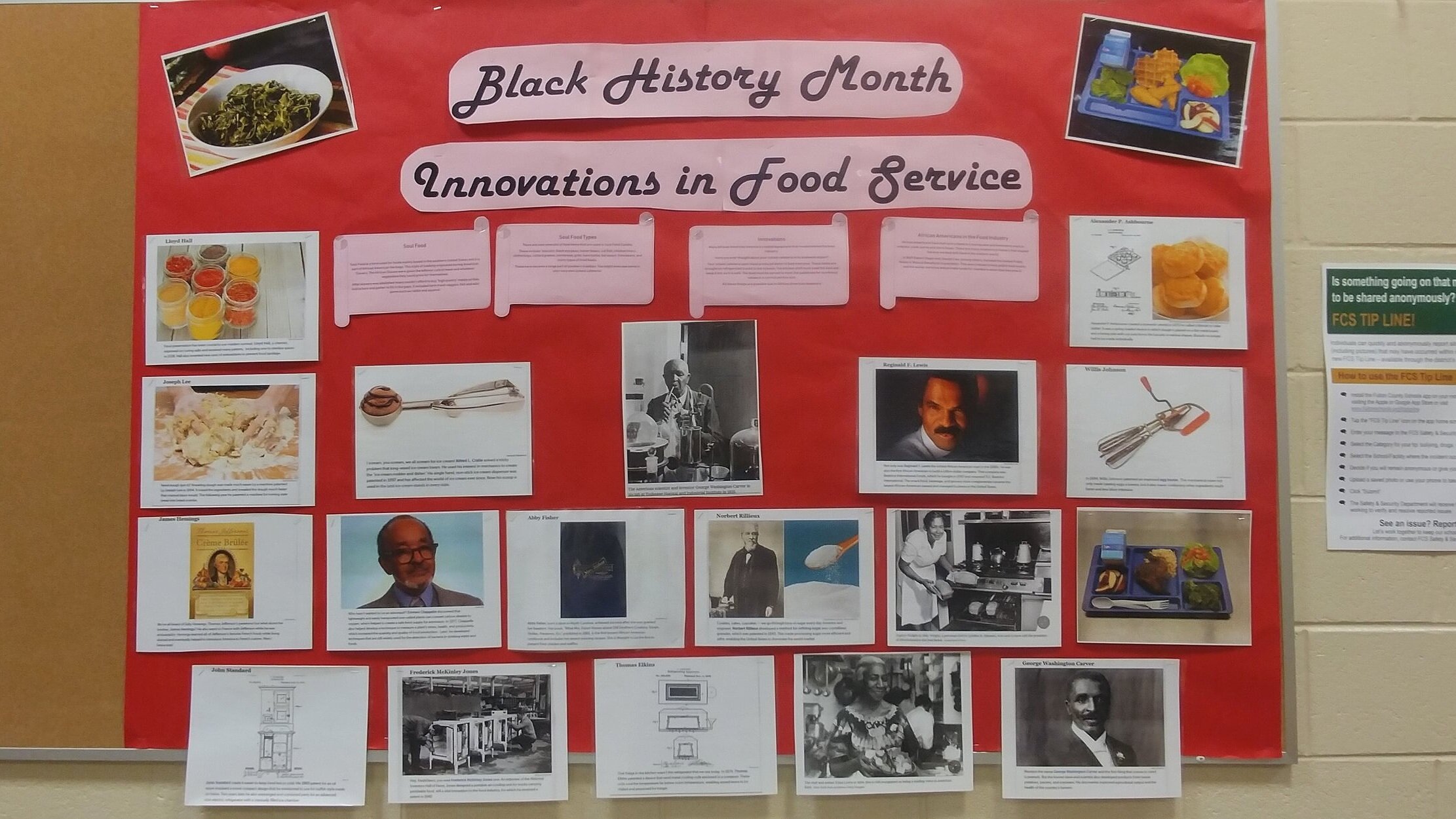
A Fulton County School Nutrition education display, courtesy of Denielle Saitta. All images are from pre-pandemic celebrations.

A Fulton County School Nutrition education display, courtesy of Denielle Saitta. All images are from pre-pandemic celebrations.

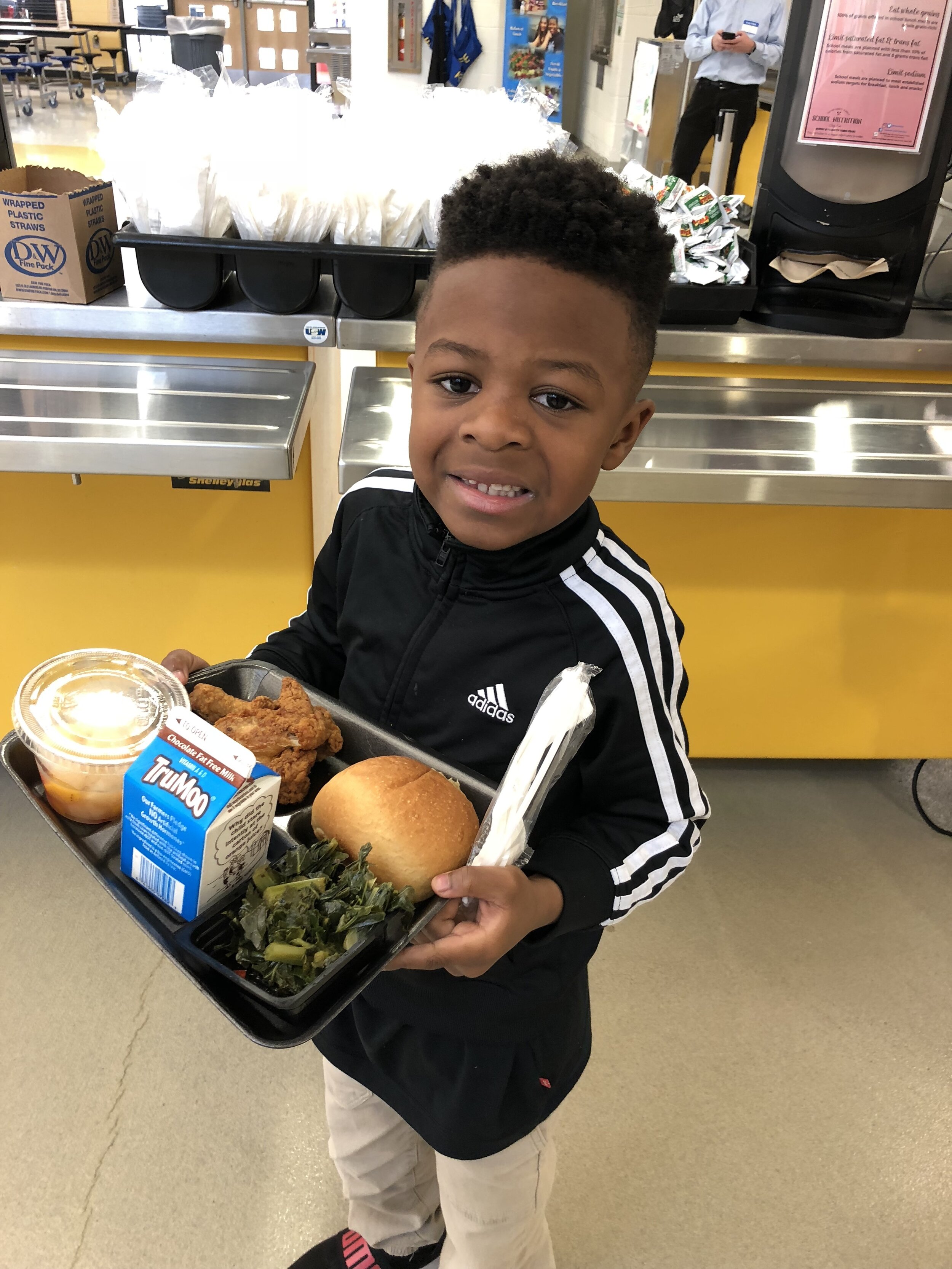
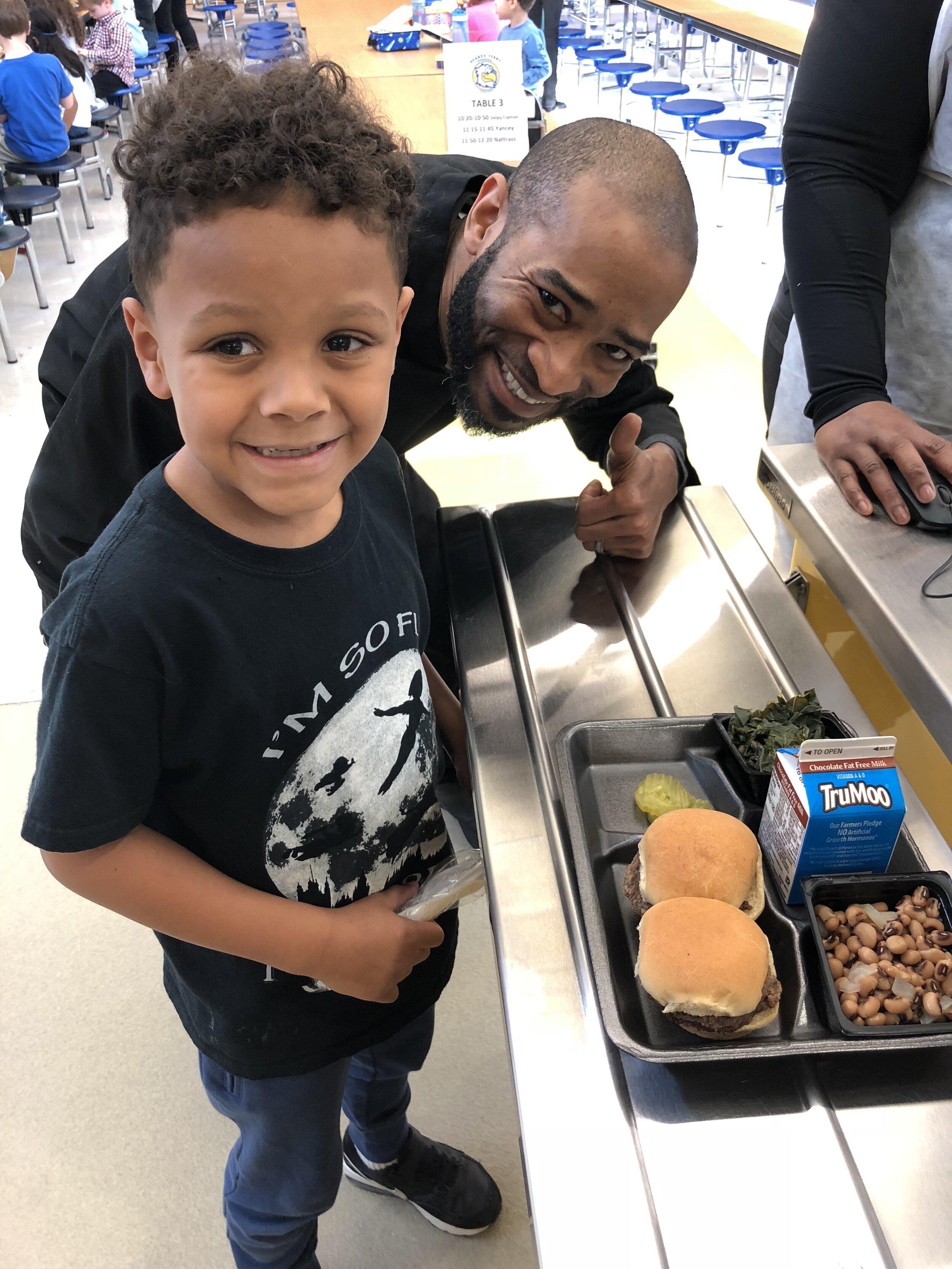
Fulton County School Nutrition has celebrated Black History Month since Denielle started in 2016. “Every year, we provide Café Managers promotional resources and nutrition education material. Some café Managers have conducted nutrition education lessons on influential African Americans in food and George Washington Carver. We offer a limited-time Southern Fare menu to students and the school community. The menu may include southern breaded chicken, locally grown collard greens, black-eyed peas, peach or apple crisp, and fresh fruit. The celebration provides students the opportunity to examine the connection between food and nutrition with African American culture and history.”  
black history celebration.jpg

Denielle notes that the Black History Month celebration is just one of many Fulton County Schools promotions that bring learning beyond the classroom and into the cafeteria. “Our cafes have always been an extension of the classroom! The Fulton School Nutrition Program helps set goals for nutrition education, physical activity, and other school-sponsored activities. All 95 Café Managers plan and implement two classroom-based nutrition education related promotions each school year. Café Managers visit student classrooms for the lesson or will have the students come to their ‘classrooms’ – the kitchen! Inviting students into the kitchen gives Café Managers a chance to show students all tools and equipment they use when preparing their school food.” 

PJST9452.JPG

Although 2021 celebrations and promotions are happening virtually and school meals are picked up curbside and enjoyed while social distancing, the Fulton County School Nutrition Program remains dedicated to serving all students nutritious, safe, and customer acceptable meals in support of academic achievement.  “For many families, schools are the one place their children can get a nutritious meal,” said Alyssia Wright, Executive Director of the Fulton County School Nutrition Program. “While the location and meal service method might be different, our students and families can count on us for nutritious and safe school meals.” This month, students can enjoy the cultural exploration and culinary celebration of Black History Month along with a delicious meal!
Danielle Saitta is the Project Manager of Marketing & Communications for Fulton County Schools Nutrition Program. To learn more about the Fulton County School Nutrition Program, please visit, https://nutrition.fultonschools.org/ and follow us on Instagram @FCSNutrition, Twitter @FCSNutrition, and at https://www.facebook.com/FCSNutrition

Kimberly Della Donna is the Farm to School Director at Georgia Organics. To learn more about Georgia Organics, visit www.georgiaorganics.org and follow us on Instagram @GeorgiaOrganics, Twitter @GeorgiaOrganics, and at www.Facebook.com/GeorgiaOrganics.

Three Locally-Inspired Winter Recipes from Recent Guests of The Atlanta Foodcast

By Mary Elizabeth Kidd

We’re sharing some warming recipes from our recent Foodcast and blog guests to keep you cozy this winter and to make great use of the season’s produce.

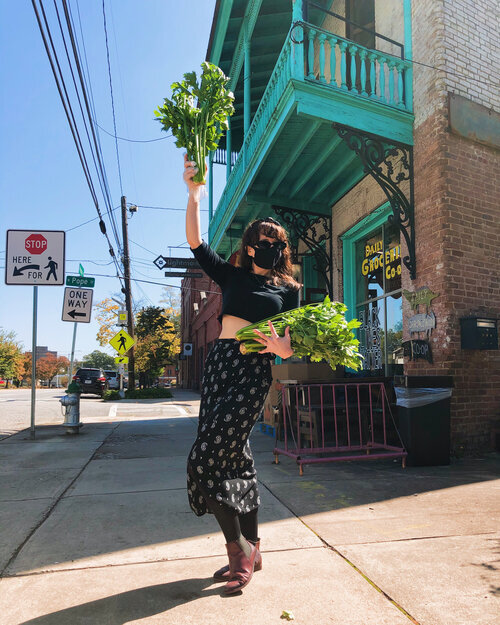
The following recipes were provided by guests of our recent episode of the Atlanta Foodcast, which featured leaders from three independent Georgia co-ops and groceries: Ahzjah Simons of Atlanta’s Sevananda Natural Foods Co-Op, Kara Brown and Theo Horne of Athens’ Daily Groceries Co-op, and Kristin Russell of Savannah’s Brighter Day Natural Foods and the Sentient Bean.

You can read more about these stores and listen to the episode at ATLfoodcast.com.


RECIPES FROM THREE GEORGIA NATURAL GROCERS

Local independent and cooperative grocers, particularly health-driven food stores, fill a special role in nurturing a holistic, connected, nourished community, so we were excited to talk to them about their role in their respective communities of Atlanta, Athens, and Savannah.

We explored how they’ve each braved the ever-changing pandemic economy and engaged with their neighbors during the ongoing pursuit for racial justice. For this episode, we also spoke to Bilal Sarwari, Membership & Communications Manager at National Young Farmers Coalition. Bilal will be joining the Atlanta Foodcast as a guest host soon, stay tuned!

You can listen and subscribe to the Atlanta Foodcast wherever you access podcasts, links and show notes are available at ATLfoodcast.com.

Enjoy the following recipes…bon appetit and remember to #StayLocal with Georgia Organics!

DAILY’S VEGETABLE SOUP

Courtesy of Theo Horne, outreach & marketing manager at Daily Groceries Co-op in Athens (dailygroceries.org/), via the Daily’s Fresh Manager, who adds: “This is a great recipe for tossing in all those veggies sitting in your fridge that are getting a little past their prime.”

Vegan, Gluten Free

INGREDIENTS

Veggies to add some heart:

  • Carrots

  • Onion

  • Celery

  • Green bell pepper

  • Potatoes

  • Zucchini

  • Curly kale

  • Cherry tomatoes

  • Approx. 1.5 Tablespoons of tomato paste

  • 2-3 Veggie bouillon cubes

  • We’ve also been known to also toss in cauliflower, radishes, shallots, etc.

Herbs & spices to keep you warm:

Start with a teaspoon of each, add more to taste:

  • Turmeric

  • Ginger

  • Curry Powder

  • Basil

  • Oregano

  • Garlic granules

  • + 1 tablespoon of sugar

 DIRECTIONS: Click here to view full cooking directions on Daily’s blog!


Savannah’s Brighter Day Natural Foods. By Mary Elizabeth Kidd.

Savannah’s Brighter Day Natural Foods. By Mary Elizabeth Kidd.

HARVEST VEGGIE BOWL

Courtesy of Kristin Russell, owner of Brighter Day Natural Foods (brighterdayfoods.com) and founder & owner of the Sentient Bean (Savannah)

Makes 4-5 servings. Vegan, Gluten Free

INGREDIENTS

1 small butternut squash

1 lb. Turnips

½ lb. Brussels sprouts

1 medium sweet onion

2 cups black rice

4½ cup water or broth

2 Tbsp. fresh chopped sage (dry works in a pinch, but reduce to 4 tsps.)

6 cloves garlic - peeled

Approx. 3 cups almond milk

1 cup cashews

Salt to taste 

Pepper to taste 

Olive Oil 

Fresh chopped parsley - optional

DIRECTIONS

Preheat Oven to 400 degrees.

Securing the base of the squash on a cutting board, cut top-to-bottom down the middle. Remove seeds. Lay on the pan with the inside facing up.  Pour olive oil and sage into the bowl of the squash and rub olive oil on the rest of the squash face.  

Peel turnips (optional), then chop turnips and brussel sprouts into bite sized pieces. Toss in olive oil and spread out evenly on a second baking pan. Sprinkle it with salt and pepper. Roast whole garlic cloves on the same pan.

Roast all veggies for 45 minutes. Check the turnips and brussels and shake the pan about every 15 minutes to prevent uneven browning. If the squash is still too firm, roast for 10-15 more minutes.

After the veggies are in the oven, start black rice in a rice maker or on the stove top. Combine water, black rice, and salt to taste. If using the stove top - over medium-high heat, bring the water to a boil. Add the salt, reduce heat, cover, and cook for about 30-35 minutes.

Spread out cashews on another pan, seasoning optional, and roast for 10 minutes. 

After veggies are done, scoop the squash meat out of the skin into a bowl. Add cashews, garlic and small amounts of almond milk incrementally until your texture is smooth and thick but able to pour.  (Almond milk varies depending on the size of the squash)

Layer the rice and roasted veggies in a bowl and top with the butternut puree. 

Great to garnish with some of the toasted cashews and fresh parsley.


Ahzjah Simons of Sevananda Natural Foods.

Ahzjah Simons of Sevananda Natural Foods.

Golden Buddah Bowl

Courtesy of General Manager and Co-Op Director Ahzjah Simons of Sevananda Natural Foods (sevananda.coop/) via Kitchen Manager Michelle Taber, who adds: “This is a great warm and filling soup recipe…not to mention one of our favorites here at Sevananda.”
Serving size 6. Vegan

INGREDIENTS
One 15 oz. earth balance spread, tub
1/3 cups celery, diced
Two 4.5 oz. jars ginger, chopped or minced
3/4 cups carrots, coined
3/4 cups onions, diced
1/3 quarts potatoes, frozen or Yukon gold, diced
Four 108 oz. cans garbanzo beans, with liquid
1/8 cup curry powder
2/3 Tbsp. cumin powder
1/4 Tbsp. black pepper
2/3 cups unchicken broth powder
1/3 quarts water
1-108 can coconut milk
1/4 Tbsp. salt

DIRECTIONS
1. Melt Earth Balance in pot
2. Sauté onions, carrots, celery, and potatoes with spices
3. Dissolve unchicken broth in water and add to pot
4. Add chickpeas, salt, and coconut milk
5. Simmer 30 minutes or until potatoes are cooked through.


Good Food for Thought: Planting an Indoor Garden with Children

By Kimberly Kooger

We enjoyed some much-needed, light fun in our virtual Good Food for Thought farm to school workshop last Wednesday, which was all about indoor gardening activities you can do with children, especially during the winter. We started with a mindful moment, in which we considered what we would like to cultivate in our students over the next few months. Answers to this prompt were varied, thoughtful, and inspiring, including the desire to cultivate “trust”, “a sense of empowerment”, “curiosity”, “impermanence”, “good caretakers”, “consistency and seeing things through”, and many others.

what to plant.png

Teacher and farm to school extraordinaire, Jenna Mobley led us through a brief overview of a seed’s basic needs with a catchy song to go along, as well as what is possible to direct-seed outdoors when it’s cold. Then she took us on a deeper dive into practical and innovative ways you can start seeds indoors, as well as other gardening explorations you can do with kids inside, connecting all of these ideas to Georgia education standards and real, practical lessons.

We ended the workshop with comments about what indoor gardening activities folks are excited to try over the next couple of months with their students, and we gave away googly eyes and seed starting mix to one of the “most spirited” participants. Some takeaways in case you missed it:  

what to plant II.jpg
  • You can start seeds in almost anything, as long as it has the ability to drain excess water, which means you don’t have to go out and buy a bunch of new stuff! We even learned how to make a simple seed starting pot with an empty toilet paper roll. 

  • Just with the simple activity of starting seeds inside, you can teach students about nurturing living things and responsibility, math, and science, and even instill in them a sense of hope for the future.  

  • When it’s cold outside, in addition to starting seedlings, there are many fun and creative garden prep tasks you can do inside in anticipation of spring planting, as well as garden-themed center activities.

    Check out some of these great ideas in the below webinar recording.

    You can sign up for upcoming Good Food for Thought sessions at gfft.georgiaorganics.org/virtual-events.


Kimberly Koogler is the Farm to School Coordinator at Georgia Organics. To learn more about Georgia Organics, visit www.georgiaorganics.org and follow us on Instagram @GeorgiaOrganics, Twitter @GeorgiaOrganics, and at www.Facebook.com/GeorgiaOrganics.
The Poor People’s Campaign Demanded Just Treatment of Small Farmers

By Porter Mitchell

Dr. Martin Luther King Jr. spent the last months of his life working with the Southern Christian Leadership Conference (SCLC) to organize the Poor People’s Campaign, also known as the Poor People’s March on Washington.  

Poor People's Campaign

Poor People's Campaign

The campaign sought to unite poor Americans of all backgrounds to demand economic and human rights. The campaign demanded an end to economic exploitation, a universal basic income, opportunities for employment, and guaranteed food and housing. In the midst of organizing the campaign and supporting the Memphis Sanitation Workers’ Strike, Dr. King was assassinated on April 3, 1968.  

Ralph David Abernathy Sr. and Dr. Martin Luther King Jr.

Ralph David Abernathy Sr. and Dr. Martin Luther King Jr.

In the wake of King’s assassination, Ralph David Abernathy took on leadership of the campaign. The Poor People’s Campaign made organized sets of demands of multiple government agencies, including the USDA at the end of April 1968.  

The campaign’s demands of the USDA centered on eliminating hunger, ending the USDA’s favoritism to large scale growers, supporting farm workers, supporting the formation of farmer cooperatives, and ending the USDA’s pervasive and flagrant practices of racial discrimination, particularly towards Black farmers.  

The campaign’s demands of the USDA were largely ignored, especially the call to end the USDA’s disgraceful practices of racial discrimination. This would again come to a head during the Pickman vs. Glickman lawsuits of the 1990s and early 2000s.  

In remembrance of King’s legacy and the countless activists who have worked for food justice and the fair treatment of small farmers, we encourage you to read the campaign’s demands of the USDA and hold time and space for reflection: bit.ly/sclcppcdemands  


Porter Mitchell is a Farmer Services Coordinator at Georgia Organics. To learn more about Georgia Organics, visit www.georgiaorganics.org and follow us on Instagram @GeorgiaOrganics, Twitter @GeorgiaOrganics, and at www.Facebook.com/GeorgiaOrganics.
 

Good Food for Thought: Winter Webinar Series with Georgia Organics Farmer Services

c72869c8-c5b9-4fc7-8abe-4b149208c87c.jpg

We are excited to host a Good Food for Thought Winter Webinar Series dedicated to topics and opportunities for convening for farmers! Registration is open for several of the following sessions, learn more below.

We will be offering these farmer-focused sessions weekly from January 20 through February 25. Topics include:

  • Employee management and fair-labor practices

  • Farm Systems

  • Regenerative Agriculture Practices for Livestock producers

  • Stress management tools

  • Wholesale & Restaurant Sales Readiness

While we wish we could convene for our annual Conference and Expo, Georgia Organics aims to continue to foster connection and educational opportunities for farmers across the state and beyond, while removing the geographic and financial barriers presented by traditional, in-person events.

To find out more and register for these sessions, visit: gfft.georgiaorganics.org/virtual-events. Hope to see you there!


WINTER WEBINAR SESSIONS, DATES & DESCRIPTIONS


Wednesday, January 20th, 4:00 - 5:40 p.m.

Continuing Towards Deep Sustainability

Presenters: Mark Cain, Dripping Springs Garden

Managing relationships, stress, and a farm business is more than enough to overwhelm many growers. Many of us run from one crisis to another, never quite enjoying any job as we rush out of fear to the next. Together we will take a look at how we create these stress patterns, and how we can work to transform them into skillful management that includes satisfaction, shared happiness, creative time-outs, and remembering why we came to this work in the first place.

Price: Donation based


 Wednesday, January 27th, , 4:00 - 5:30 p.m.

Pasture Progress: A Closer Look at NRCS Programs for Livestock Farmers

Presenters: Bryan Hager, Crager Hager Farm. Ricky Dollison, Dollison Farms

Curious about livestock management systems that can save you money, build soil health, and improve your farm? From rotational grazing, seeding pastures, wells and watering to native forages and shade enclosures, choosing what to incorporate into your management system seems like a headache. Fortunately, The Natural Resources Conservation Service (NRCS) is there to help! NRCS provides free technical services and financial assistance to help farmers and ranchers improve their operations. In this session, learn how you can access NRCS programs for your livestock operation and hear from farmers with real experience working with the NRCS. While this session has a Georgia focus, the NRCS is a federal program located in every state so tune in!

Price: Member Price - $5.00 | General Farmer - $10.00| Non Farmer - $15.00


Wednesday, February 3rd, 4:00 - 5:30 p.m.

Farm Proven Strategies for Employee Management and Retention

Presenters: Paul and Lindsey Sorah of Hearts of Harvest Farm

Presenting: Paul and Lindsey Sorah of Hearts of Harvest Farm. This session will cover: The Sorah’s workflow for managing staff including check-ins and employee reviews Cultivating employees that are invested in your farm’s success The real cost of staff turnover and why investing in staff actually saves you money Management strategies to encourage retention Planning for payroll, balancing cash flow for payroll between peak season and slow season What qualities to look for when hiring While this session will have a farm focus, techniques and methods discussed apply to any manager or small business owner.

Price: Member Price - $5.00 | General Farmer - $10.00| Non Farmer - $15.00


Tuesday, February 23rd, 4:00 - 5:40 p.m.

Part 1: Choosing Markets & Managing Revenue Streams

Presenters: Lauren Cox, Georgia Organics

Join Lauren Cox, of Georgia Organics for this strategy-focused session that will help you think explicitly about the different revenue streams your farm business can access, what that means for your annual workflow, and how to pinpoint opportunities for expanding these markets or tightening them up. This session is best for diversified producers, beginning, intermediate, advanced farmers, and growers interested in diversifying revenue streams.

Price: Member Price - $10.00 | General Farmer - $15.00 | Non Farmer - $20.00


Thursday, February 25th, 4:00 - 5:40 p.m.

Part 2: Dish Dive into Wholesale and High-End Wholesale

Presenters: Lauren Cox, Georgia Organics, Neil Ringer, Common Market Southeast and Zac Harrison, Fresh Harvest

Are you interested in expanding your farm sales to restaurants, local aggregators, or CSA styled box programs but don’t know where to start? Lauren Cox, a former farmer who now runs Georgia Organics’ Farm to Restaurant program, will help you unpack some of the issues and barriers in getting your food from farm to restaurant along with key considerations for becoming ‘restaurant or wholesale ready.’ Topics include time/profitability assessment, successive planting techniques, ideal crop varieties, availability lists, and packaging strategies, along with a task-oriented breakout session.

Price: Member Price - $5.00 | General Farmer - $10.00| Non Farmer - $15.00


PRICING & DETAILS

Pricing:

We acknowledge the financial constraints the pandemic has caused for many folks, as such, Georgia Organics will offer a tiered pricing scale, donation- based, or free admission to this year's Good Food for Thought workshops. We want to ensure everyone who wants to attend a workshop will be able to do so!

Tiered Admission Cost:

·         Georgia Organics Farmer Member: $5.00

·         Non- Member Farmer: $10.00

·         Non- Farmer: $15.00

** You must apply the Georgia Organics Farmer Member Promo Code at check out to the discounted rate. ** To request this promo code, email info.georgiaorganics@gmail.com.

We hope, with funds generated from these virtual workshops, that we can continue to provide educational and convening opportunities while offering scholarship funds to cover the cost of admissions when needed. Please contact Ashley Dowling at ashley@georgiaorganics.org with any questions or requests you may have regarding scholarship opportunities to attend the session at a further discounted rate.

If you have questions about the status of your Farmer Membership, please email contact Caroline Croland at carolinec@georgiaorganics.org. To receive the Farmer Member discount code please contact Porter Mitchell at porter@georgiaorganics.org.

To support our work, please consider becoming a member or making a one-time donation by clicking here.

Refund Policy:

Due to the virtual nature of this event, no refunds will be given. Ticket purchasers will have access to the session's recording following the live event.

Community Commitments:

Georgia Organics encourages attendees to actively participate and engage with our programming. Our organization values creating accessible and inclusive opportunities for convening and learning. We expect attendees to commit to participating in that same spirit.

We agree to honor the following community commitments when participating in a Georgia Organics organized workshop, training, or convening. We commit to:

·         Fostering collaborative discussion

·         Respecting the experiences and opinions of others that may diverge from our own

·         Creating a space that is free from harassment of any kind including offensive, divisive, and profane language

·         Willingness to step back after making a contribution so others can participate

·         Speaking for yourself and from your own experience

·         Being patient as technical issues may arise

Staff, speakers, and attendees are expected to honor these commitments. Georgia Organics reserves the right to revoke live event access if Community Commitments are broken. No refunds will be given to attendees who are removed from the event for violation of these standards.

Love is Love Farm at Gaia Gardens

Love is Love Farm at Gaia Gardens

The Atlanta Foodcast Returns: In Conversation with Twisted Soul & Ellijay Mushrooms and Crystal Organic Farm

By Mary Elizabeth Kidd

Welcome back to another year of conversations with farmers, chefs, community activists, and other food leaders around Georgia!

The year has been and continues to challenge, but our hope with the Atlanta Foodcast is that hearing from these incredible people will bring you inspiration. These are the leaders working hard to establish an equitable, regenerative food system for all Georgians.


On today’s episode, we’re connecting with a farmer-chef duo who participated in our Farm to Restaurant program’s Food Fight GA initiative: Chef Deborah VanTrece of Twisted Soul Cookhouse & Pours (www.twistedsoulcookhouseandpours.com/) and Howard Berk of Ellijay Mushrooms (ellijaymushrooms.com/).

Chef Deborah VanTrece of Twisted Soul Cookhouse & Pours and Howard Berk of Ellijay Mushrooms.

Chef Deborah VanTrece of Twisted Soul Cookhouse & Pours and Howard Berk of Ellijay Mushrooms.

Twisted Soul Cookhouse & Pours is located on the Westside of Atlanta and serves “globally-inspired Soul food with an emphasis on farm to table.” Chef VanTrece’s goal is to serve food that evokes memories and reflects comfort foods from around the world, inspired by her extensive travels. 

Howard Berk, co-owner of Ellijay Mushrooms, where they grow Shiitake and Oyster mushrooms and are currently developing Lion’s Main and other varieties. 

They discuss how a partnership like theirs—relatively close to home—was essential as the global food chain essentially broke down at the outset of the COVID-19 pandemic.  

For Chef VanTrece and the Twisted Soul team, this was an essential time not only for the relationship with Ellijay Mushrooms, but also to work with additional farmers as the availability and proximity just made sense and has continued so to this day.  

“Now I use more local farmers than ever before…this was the system that actually saved us, the relationship with farmers. We went through all sorts of different pivots, but one that was most important was being able to offer fresh, locally-grown vegetables; it was of major importance...It’s made me understand that my relationships have to continue to be strong with our local farmers. It’s a win-win for both sides when that happens. We as restauranteurs have learned how important our farmers are to the food chain of America.” 

Chef VanTrece has a cookbook is on the horizon: “The Twisted Soul Cookbook: Modern Soul Food with Global Flavors,” available for pre-order now. To view the Twisted Soul menu and order pick-up, visit: www.twistedsoulcookhouseandpours.com/. Follow on social media at facebook.com/twistedsoulcookhouse/ and @twistedsoulcookhouse.  

On the horizon for Ellijay Mushrooms: they are moving towards a zero-waste operations with composting for local farmers and, in the next few years, a U-Pick mushroom  program, yoga at the farm, and more. Visit ellijaymushrooms.com/ to view their offerings and order for safe pick-up. Howard’s main ask? Support the restaurants that are buying from Ellijay Mushrooms (list available here). Follow on social media at www.facebook.com/EllijayMushrooms and @ellijaymushrooms.  


Jeni Jarrard & Nicolas Donck of Crystal Organic Farm.

Jeni Jarrard & Nicolas Donck of Crystal Organic Farm.

In our second segment, we’re talking to Nicolas Donck & Jeni Jarrard of Crystal Organic Farm. Nicolas established Crystal Organic Farm over 27 years ago and the 175 acre farm, located about an hour outside of Atlanta, has been certified organic ever since.

We talk about how their business’ continual evolution, from serving some of Atlanta most renowned chefs such as Chef Gunter Seeger, to helping establish the Morningside Market, to now offering COVID-safe on-farm pickups, homeopathic remedies, and stress-relieving farm tours.

Throughout the farm’s existence, they have also committed to giving back as much and often as possible. They currently operate the Crystal Organic Farm Food Assistance Program, providing weekly fresh produce bags, at no cost, for members of their community. If you or someone you know is in need of food, contact Crystal Organic Farm (link here) or send them a message on social media.

To learn more about Crystal Organic Farm and shop, visit crystalorganicfarm.com/. Follow them on social media at facebook.com/crystalorganicfarm/ and @crystalorganicfarm.

For our recurring Gardening with Farmers, Nicolas is sharing his expertise on winter gardening for the cold months. 

Thank you for joining us for another season of The Atlanta Foodcast! Be sure to subscribe, rate, and review us wherever you listen to podcasts. We also encourage you to Stay Local this year and support their work. You can learn more about the Georgia Organics Stay Local campaign at georgiaorganics.org/staylocal.


Mary Elizabeth Kidd is the Communications Director at Georgia Organics. To learn more about Georgia Organics, visit www.georgiaorganics.org and follow us on Instagram @GeorgiaOrganics, Twitter @GeorgiaOrganics, and at www.Facebook.com/GeorgiaOrganics.
Guest Post: Holidays with Farm to School Partner Little One’s Learning Center  

By Chef Shay at Little One’s Learning Center

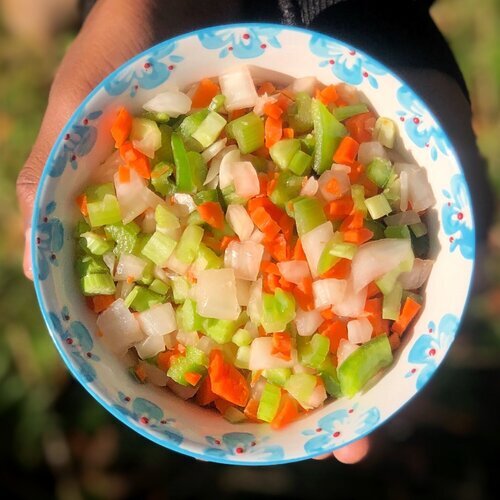
Little Ones Learning Center is a model of Farm to ECE in Georgia. The school garden is a place of learning and exploration, where students gain the life skill of growing food and showing love and appreciation to Mother Earth. School meals and taste tests expose students to a variety of local fresh food to expand their palates, develop cultural awareness for where food comes from, and support brain development. This simply delicious sweet potato recipe is Little One's Learning Center Chef Shay's favorite holiday recipe, and it is sure to be one of yours. 
 

Photo courtesy of Little One’s Learning Center.

Photo courtesy of Little One’s Learning Center.

Best Mashed Sweet Potatoes 
 

Ingredients 

4 lbs. sweet potatoes (about 5 large or 4 extra large)*, such as red garnet, beauregard or jewel (not white or purple varieties) 

8 Tbsp salted butter, diced into 1 Tbsp pieces, plus more for serving if desired 

1 Tbsp real maple syrup, then more to taste for a sweeter option 

Salt and freshly ground black pepper 

How to Make Mashed Sweet Potatoes 

Making mashed sweet potatoes is really easy!  I make Baked Sweet Potatoes and scoop them out to make mashed potatoes. A quicker method is to boil the sweet potatoes but I prefer the consistency of baked if possible. 

Once cooked (either boiled or baked) and very well drained, the sweet potatoes can be mashed. 
Start by adding the butter and mixing it in using a hand masher. 

Heat the cream/milk and add a bit at a time while mashing. You can use an electric mixer for a creamier texture or mash by hand. 

Once mashed, season with salt and pepper and serve (with more butter  (LOTS MORE!). 

Sweet Potatoes, take a short amount of time to boil, 15-20 minutes or until tender when poked with a fork.  

How to Mash Sweet Potatoes 

You can mash sweet potatoes using a hand masher, this gives more of a rustic consistency. 

For a smoother consistency, you can use a hand mixer or an immersion blender.

Enjoy!

Photo courtesy of Cosmos Farm.

Photo courtesy of Cosmos Farm.


Mid-Week Pop-Up Market: Best Practices and Reflections

By Mary Elizabeth Kidd

On Wednesday, April 26, just over a month after the pandemic took full effect in Georgia, Georgia Organics launched a weekly market with online ordering from small, local farms and COVID-safe, touchless pick-up at Wrecking Bar Brewpub in Inman Park.

When the Georgia Organics Mid-Week Pop-Up Market ended for the season on Wednesday, Dec. 2, the overall performance was assembled alongside best practices and learnings and shared via a Good Food for Thought webinar with a community of interested attendees from Georgia to Massachusetts, Florida, Washington, Alabama, Minnesota, and beyond. Georgia Organics believes this is a market model that individuals and cooperatives in Georgia and beyond can replicate to foster farmer prosperity in their respective communities.

128097763_10157600896826782_2743970939169860279_n.jpg

Over its 32-week run, the Georgia Organics Mid-Week Pop-Up Market served an average of 45 customers per week and helped eight small farms secure over $55,000 in sales to help re-establish some of the pre-pandemic business lost over the tumultuous year of restaurant closures, changes in wholesale channels, and other sales interruptions.


F2R Mid-Week Pop-up Header WEB.png

To develop the concept and detailed logistics, members of the Farmer Services, Farm to Restaurant, and Events teams combined their personal experiences farming as well as participating in and coordinating farmers markets to develop an experience that would meet the safety needs of customers and the sales needs of farmers. The goal of this pop-up market was to serve the needs of customers looking for a Covid-safe, farmer-supporting shopping option and, primarily, to enact Georgia Organics’ goal of fostering farmer prosperity.

The Mid-Week Pop-Up Market ended after a successful 32-week run on Wednesday, Dec. 2 and, per our recent Good Food for Thought webinar, has proven to be a highly replicable model for communities looking for alternative, manageable ways to offer a safe, smaller market experience.

While the market ended for the season on Wednesday, Dec. 2, Georgia Organics is passing the proverbial baton to a cooperative of small farmers and hope to continue sharing learnings and advice from this model so that communities in Georgia and beyond can establish their own pop-up markets.


On Dec. 9, Georgia Organics hosted a Good Food for Thought webinar for those interested in beginning an online-driven, safe pickup pop-up market. The Zoom call was led by Kayla Williams, Farmer Services Coordinator with Georgia Organics, who primarily managed the Mid-Week Pop-Up Market, and Lauren Cox, Organic Procurement Coordinator and manager of our Farm to Restaurant program, along with Mid-Week Pop-Up participating farmer Rahul Anand, owner of Snapfinger Farm in Stockbridge.

All participating farmers in the Mid-Week Pop-Up Market were a part of the Farm to Restaurant program’s Farmer Cohort, a group selected for restaurant-specific direct support, training, farmer-chef partner building, and other resources to help foster a more transparent and flourishing “farm to table” economy in Georgia. To learn more about the Farm to Restaurant program, visit farmtorestaurant.georgiaorganics.org/.

In the Good Food for Thought program, Lauren and Kayla shared some of the essential learnings and findings from this 32-week initiative, including the basics of why and how Georgia Organics launched the pop-up market and how others can recreate this online, touchless weekly event.

A few of the foundational factors making this a successful market included strong pre-existing relationships with the team at our host site, Wrecking Bar Brewpub, a Farm to Restaurant Farmer Champion restaurant with an idea event space tied to the restaurant and parking spots for farm-to-trunk curbside pickup. Additionally, the labor of these weekly markets was no small feat, Kayla shared, taking around 8-12 hours of weekly coordination and on-site labor to pack and distribute orders.

mwp.jpg
mwp.jpg

Finally, it was important to have the Georgia Organics-hosted Mid-Week Pop-Up website (bit.ly/midweekpopup), designed via Squarespace, where customers could be directed to the online stores of participating farmers. Ongoing marketing via an email newsletter and social media promotion served as reminders for the ordering window and pick-up days and also introduced prospective customers to the participating farmers.

Participating farms in the Mid-Week Pop-Up Market 2020.

Participating farms in the Mid-Week Pop-Up Market 2020.

For the farmers, a few key operational factors made this market successful: Mid-week scheduling aligned with farmers pre-existing commutes into Atlanta to drop orders at restaurants and, crucially, the online functionality that was possible as most participating farmers had already transitioned to online stores within their weekly sales flow.

The fact that this market served only online pre-orders was a significant differentiator of this pop-up market vs. traditional farmers markets and in-person or on-farm sales.

Atlanta Harvest CSA order at the Mid-Week Pop-Up Market.

Atlanta Harvest CSA order at the Mid-Week Pop-Up Market.

A few measurable results of the online, touchless market: foot traffic was lower, the average customer was older, and the spend-per-customer was higher on average, around $35.

Additional logistics details and results were shared in the Mid-Week Pop-Up Market: Best Practices and Reflections webinar, watch below.


Rahul Anand of Snapfinger Farm

Rahul Anand of Snapfinger Farm

When asked about the impact of the Mid-Week Pop-Up Market, Snapfinger Farm’s Rahul Anand responded that the Mid-Week Pop-Up Market, over the 32 weeks running, accounted for 3-4% of Snapfinger’s total sales. “While that number might seem small. It’s big. When you take what that means week-to-week over 30 weeks with payroll going out; it’s really not an insignificant amount of money. It made the logistical burden of changing up where we’re selling things a whole lot easier,” Rahul added. 

Farmer EliYahu Ysrael of Atlanta Harvest, another Mid-Week Pop-Up participating farmer, added: “This program has been absolutely amazing. A great way to bring different organizations together that commit to creating a better environment for food. Allowed farmers to have direct access to customers and share resources so that the growers can spend the much needed time in the field and know that food being grown is going to homes in our city.”


Stay tuned to Georgia Organics’ social media for updates about the Mid-Week Pop-Up continuing in 2021!

To watch this Good Food for Thought webinar in full or view the slides from the presentation, click below. Click here to download the full presentation deck.


To learn more about the Farm to Restaurant program, visit farmtorestaurant.georgiaorganics.org/.

If you have questions about how to start an online-driven pop-up farmers market in your community, send an email to info.georgiaorganics [at] gmail [dot] com.

Innovation and Passion Drive Farm to Early Care Education at Pre-K Preparatory Academy

By Yaza Sarieh

Some educators may think that getting small children to try fruits and vegetables can be a daunting task, but not for Arbendette Van. The director of Pre-K Preparatory Academy in Gainesville, GA, Arbendette Van has excited her students, faculty members, and families about local foods and nutrition education. Having joined the Farm to Early Care Education Collaborative over a year ago, Arbendette has done amazing work to incorporate Farm to Early Care Education in everything they do in the classroom.

Prekprep3.jpg

After a career in the corporate world, Arbendette Van followed her lifelong passion for working with low-income communities and educating children by establishing the Pre-K Preparatory Academy. The Farm to Early Care Education program at Pre-K Prep began due to Arbendette’s interest in local food and the health benefits of eating goods grown in the local community. She was inspired to challenge each classroom to integrate healthy foods and nutrition into their curricula, which began with a garden competition using bathtubs as planters and some seeds to see which produce grew the fastest. What started as a small contest quickly developed into a school-wide incentive to create more opportunities for the students to engage in F2ECE.

The Farm to Early Care Education initiatives has benefitted the community, as Pre-K Preparatory Academy has built a large garden, created activities and curricula with the help of Georgia Organics, and set a standard for eating local. According to Arbendette, one of the most rewarding products of the Farm to Early Care Education work has been the student’s joy for healthy eating. She said, “One of our moms took her kids to Florida for a vacation, and someone commented on how amazing it was that her children were not eating candy or junk food, but that they were happy to eat vegetables and fruits.”

The Farm to Early Care Education program has encouraged student’s excitement because they are included in all elements of growing, harvesting, and serving. The children not only plant the seeds and “love to poke holes in the ground,” but they are also responsible for watering the garden and tending to its needs. She has done a fantastic job of including sustainable practices in her own garden, by using recycled planters like tires and milk cartons, and utilizing compost so as not to waste any scraps from the kitchen. While learning more about the ecological systems in the garden, one classroom even did a research study on the different types of worms that would support prime growing conditions and had the children find those worms around the playground and relocate them to the garden. After harvesting the plants, students have prepared meals to be taken home to share with the parents. Arbendette has noticed that “The students are so interested in the growing process and working in the garden that it encourages them to try the produce – they are so eager that some of them want to try immediately after they help harvest!”

Despite challenges that have arisen from the COVID-19 Pandemic, Arbendette has not stopped her F2ECE activities – in fact, she has taken this time as an opportunity to grow the program. With the help of parents and staff, Pre-K Prep has just constructed a greenhouse and Arbendette hopes to continue increasing the garden in the next year.

One of Arbendette’s goals is to expand the Academy’s procurement of local food, specifically working with POC farmers who use sustainable growing practices. The most challenging part of procuring local foods has to do with logistics. Many Georgia farms do not have the capacity to deliver long distances at this time. The Gainesville farmers market is during school hours on a Friday, which excludes the market at a procurement option. Because the school has a smaller number of students, it is difficult to find farms with order minimums that fit her needs. However, Arbendette has not given up and still does all she can to eat local – whether it is going to Kroger multiple times a week, or continuing to connect with distributors – she is steadfast in her priority of providing healthy foods to her students and community.

With the dedication of school faculty and the support of Georgia Organics resources, Pre-K Preparatory Academy has become a model of best practices in Farm to Early Care Education.


To connect with Pre-K Preparatory Academy, visit http://www.preparatorylearningacademy.com/ and follow them on social media at www.facebook.com/prekpreparatory/ and www.instagram.com/prekprepacademy/.

Yaza Sarieh is a contractor for Farm to School at Georgia Organics. To learn more about Georgia Organics, visit www.georgiaorganics.org and follow us on Instagram @GeorgiaOrganicsTwitter @GeorgiaOrganics, and at www.Facebook.com/GeorgiaOrganics. 

Chef Asata Demonstrates How to Turnip the Volume for October Farm to School Month

By Caroline Croland

Are you ready to Turnip the Volume with Chef Asata? 

As October Farm to School Month has drawn to a close, Georgia Organics would like to take some time to celebrate Chef Asata Reid. 

Chef Asata Reid (Photo courtesy of Chef Asata Reid).

Chef Asata Reid (Photo courtesy of Chef Asata Reid).

An invaluable Farm to Early Care Chef Educator here at Georgia Organics, Chef Asata is a Farm to School all-star. She has almost two decades of experience as a professional chef and community health educator. With an honors graduate of the International Culinary School at the Art Institute of Atlanta, a cum laude graduate of Florida A&M University’s School of Journalism, an honors recipient with a Masters in Education from the University of Kansas, and a Master of Public Health from Emory University, Reid brings a wealth of knowledge to Georgia Organics’ Farm to School program. 

In addition to her extensive educational background, Reid is also the CEO of Life Chef LCC, creates educational videos for DECAL and Quality Care for Children, creates taste tests for Small Bites Adventure Club, and is releasing her first book, “How to Feed a Kid” before the end of the year. 

“Chef Asata is brilliant, creative, pragmatic, funny, and relatable, all at once. With an extensive educational background in the culinary arts, education, and public health, as well as practical, first-hand experience as a mother, Chef Asata brings a wealth of experience and expertise to the farm to school table,” says Kimberly Koogler, Farm to School Coordinator at Georgia Organics. “In training and workshops she delivers, she makes real connections with the audience and provides practical guidance based on a tried and true experience, often in a way that also makes you smile and laugh.”

Chef Asata recently created six recipe videos for Georgia Organics’ “Turnip the Volume: Can you dig it?” Farm to School month campaign. 

Whether it’s learning about fractions and photosynthesis while making Turnip Carrot Slaw, or states of matter while creating a delicious turnip stew, Chef Asata’s recipes turn delicious cooking into a memorable, hands-on learning experience. 

We sat down with Chef Asata to talk with her about her work and her passion for Farm to School education. 


Tell us a little bit about your background and experience as a chef and an educator.

I’ve been a professional chef for almost two decades. After I started my business Life Chef, I realized how much I love helping people learn to improve their lives, so I have expanded my practice beyond teaching cooking and nutrition into other areas of health and wellness. As a community health educator, it is important to me that anyone who attends my classes or seminars walks away with actionable items to immediately apply to their lives. No matter how old or young, we can all learn something to help us achieve our health and wellness goals. Even better if we can do it by eating delicious food in the process!

Photo courtesy of Chef Asata Reid.

Photo courtesy of Chef Asata Reid.

What inspires you about your work?

I think the “a-ha!” moment when someone grasps a concept or technique and now owns it for themselves is really what keeps me going. I want people to feel empowered in their lives, in their bodies, in their kitchens, in their decisions. When someone gains knowledge, they can wield that knowledge to benefit themselves. I think that is at the core of teaching. So when a parent feels like they can get a balanced meal on the table for dinner, or a college kid feels like they can eat healthy on a budget, or a senior citizen can stretch their food dollars further, or a child tries a new vegetable and likes it… all of those scenarios include a person gaining knowledge and applying it to their life. So basically, when you learn and grow, that inspires me.

Tell us about some of your favorite experiences that you have had collaborating with Georgia Organics and our Farm to School Program.

Over the years, some of my most rewarding work has been with Georgia Organics and the Farm to School and Farm to ECE programs, because these initiatives aren’t just about putting fresh produce in front of kids. These initiatives are about building communities, and food is the medium through which communities are fostered. The Farm to School/Early childhood education programs builds bridges between farmers and schools/ECEs and that’s a great thing, especially if local foods are served in meals and local dollars stay in the community. But it’s so much more than that. We work to empower the nutrition staff to embrace local and fresh produce and train them in recipe development and in thinking of themselves as educators as well. With that mindset, we can also build bridges between the kitchen/cafeteria and the classroom. In the classroom, we can bridge Farm to School/ECE goals with the curriculum so that children can learn about food from many different angles. Not just nutrition and health, but culture, community, commerce, and their learning objectives from science, math, literacy, and more. Farm to School/ECE can strengthen the bridges between the classroom and home for students and parents. Through Farm to School/ECE, food serves as a powerful conduit of information, connection, learning, and sharing and I’m proud of the work we have been able to do and am humbled by the many lives we have touched.

Photo courtesy of Chef Asata Reid.

Photo courtesy of Chef Asata Reid.

Why do you choose to work with Farm to School and Farm to Early Care initiatives?

I fully believe that if children grow up connected to their food, the people who grow it, harvest it, distribute it, and cook it, they will have a more holistic understanding of food, and not tend to separate food from nutrition, and food from agriculture. To me all three of those topics are intertwined and to understand one, you have to have an understanding of the other three. Research has shown us that children who learn what I call “food literacy” in these early years of life have better success at being healthy eaters and having a healthy attitude about food. Just as math and language literacy starts in the early years, so does this “food literacy.” If we want to turn the tide of some of the health crises that are so glaring in America, we have to start with our children and we have to include our communities. The problems of food insecurity, food apartheid, affordable health access and equality, community equity, and sovereignty are complex and multi-tiered. But one thing we can all agree upon is that people have to eat, and equal and fair access to food should be a basic human right. Working with Farm to School/ECE initiatives allows more than just interaction with kids (which I love!) but also provides an opportunity to impact the food policies and purchasing power of schools and ECEs, which has a financial impact on local businesses and farms, a health impact on the students and staff, and ultimately takes steps to build a future where kids and their food may be separated by just a few miles. Farm to School/ECE work gives us all an opportunity to reprioritize food as activism. Some of what we do is so simple, but everything we do is a building block, and with intention and over time, each school or early education site can be a house of opportunity for grassroots food activism. In that way, I believe we can reclaim food as a human right and change the world.

One simple thing that an early care provider or parent can do to make eating veggies exciting for their children? 

Photo courtesy of Chef Asata Reid.

Photo courtesy of Chef Asata Reid.

To be honest, eating veggies doesn’t have to be “exciting,” it just needs to be normalized. I don’t know that dinner needs to be a sideshow every day, it just needs to be eaten. And sometimes I think adults have expectations that are too high when it comes to what and how kids eat. If eating vegetables is normalized, if it’s “just what we do,” then it isn’t something that has to be overemphasized and kids don’t need so much coaxing. I always say a parent’s job is to provide healthy meals at regular mealtimes. That’s super simple, but that’s it. If there were one other thing I’d add to that, it would be: make sure the food tastes good. I know that seems obvious, but in so many settings, both at school and at home, adults are more focused on checking nutrition boxes. “Was a vegetable served? Yes. Was it green? Yes? Was it eaten? No.” You know why? Because it was overcooked, mushy, and gross. Before “Was it served?” somebody should’ve asked, “Does it taste good?” Kids have spectacular, vibrant, sensitive palates which means they love appealing flavors and textures and are very put off by unappealing flavors and textures. I think adults would have more success if they prepared veggies in ways that enhance their natural deliciousness and normalized eating veggies by modeling that behavior themselves. Parents should also recognize that they are in it for the long-game and that growing and nurturing a “healthy eater” can take all of the 18 years we have with our kids.

What projects are you working on right now?

We are in the throes of Farm to School Month so we just released the Georgia Organics Turnip the Volume Videos. I will be doing some training videos for family home care providers under Georgia Quality Care for Children, and some training videos for Bright from the Start DECAL. I am very excited to launch my book “How to Feed a Kid” before the year is over. It is a guide to help parents navigate some of the major pitfalls we encounter in feeding our kids well over the years. It is a quick, light-hearted read packed with my years of experience of feeding kids of all ages. And as always, I have projects in the works with my partners at Georgia Organics, Small Bites Adventure Club, the National Farm to School Network, and more to continue working on the behalf of kids, families, schools, and communities to have access to food education and food empowerment.


Spotlight on Farmer Fund Accelerator Rag and Frass Farm

By Kayla Williams

A few weeks ago, we had a conversation with Julia Asherman, farmer and owner of Rag and Frass Farm in rural Jeffersonville about...EVERYTHING. Rag and Frass Farm, an inaugural Farmer Cohort member of Georgia Organic’s Accelerator program, is an organic flower and produce operation growing on 2.5 acres. Julia has been operating Rag and Frass Farm for 7 years and farming for 9 years. Rag and Frass Farm sells their products through many avenues – the Mulberry Market in Macon, the Green Market in Milledgeville, the Grant Park Market in Atlanta, and through their own farm stand. You can find more information about where to buy from Rag and Frass here.

download (1).jpg

I have been case managing for Rag and Frass Farm throughout the Accelerator program and feel lucky to be working with such a strong, motivated, and smart grower. I could have summarized our conversation, but Julia’s words were too impactful and honest for me to do any mincing…


Why did you choose to be a farmer?   

I don’t even really remember farming being a choice…it was more of happenstance – the things I wanted in life were most readily available if I became a farmer... I wanted to live in the country, have a big garden, have more independence, and be more sustainable. I just thought I’d be a rural person who lived in the country. When I was 19 or 20 in art school in Chicago and thinking about what was after college. For me, it wasn’t about food production or business, but more about being away from police, loving art, liking science, loving plants, and wanting to carve out space in the world for myself. It wasn’t that I was ever hooked – just made a decision to do something, and it just happened to be my calling. As a kid, I wanted to be an inventor – that really is what farming is, a marriage of art, science, philosophy, building processes, problem-solving. I really like being challenged and figuring it out.   

Rag and Frass Farm. Photo credit: Kate Blohm

Rag and Frass Farm. Photo credit: Kate Blohm

What happened when you told your family you were going to be a farmer?   

I didn't have much to lose because I was really young and because I was in art school to be an artist, they had already made peace with the fact that I was going to do my own thing and probably wasn’t going to be wildly financially successful, so that made it easier for them to be OK with. And there just generally there wasn’t a lot to lose. They weren’t initially supportive but not shocked, and I’d always been the black sheep of the family. I come from a gardening family – both my parents, my aunts and uncles, my grandmother, all gardened and we went to the farmers market growing up so I didn’t have to convince them that it was important. Now that I’ve been farming for a while, they are all in, sending Boston Globe articles about local food. They’re just happy that it worked out.   

What piece of advice helped you when you were just starting out?    

A little bit of advice I didn’t take but I should have – protecting yourself and your investment. Starting as an apprentice or a tenant farmer, I was naïve about investment and ownership. Even if you put 110% effort into the farm you’re working on, you own 0% of it. It’s very easy to be taken advantage of when you’re so enthusiastic and love the work and the people you’re working for will let you do it.   

Photos courtesy of Rag and Frass Farm

Photos courtesy of Rag and Frass Farm

Screen+Shot+2020-10-20+at+11.19.31+AM.jpg

What advice do you have for beginning farmers?   

Consider your own equity and worth, and make sure you don’t have any illusions about your ownership. It’s important to give full consent and fully understand what you are getting out of the experience. Your manager may be someone fully invested in your future and it may be someone who’s not, so be cautious.   

What are your biggest moments of gratitude as a farmer?   

When it’s raining and customers come out – when you’re going through a hard time and people show up, that makes me feel a lot of gratitude. When people put their money where their mouth is and choose integrity over comfort, that makes me feel grateful. When folks are doing the right way, and it has a positive impact, that makes me grateful.     

What's a skill you have that makes you a better farmer, but you didn't initially think it would help you?    

Knowing how to handle money and business-y things in general. All of the boring, dry, numbing, capitalistic parts…but have made me viable. Becoming a part of the system enough to stay alive. Knowing how to work the system, knowing how it functions, and also recognizing the parts of the system that aren’t wrong. Just because you’re anti-capitalist doesn’t mean that record-keeping and data and keeping track of money is wrong. There’s nothing wrong with that and it makes your life easier. And recognizing that farming IS a business and it’s a business by the nature of the fact that you’re making an exchange. The notion that farming is fun and good and pleasurable and there are no problems is wrong and also, it shouldn’t have to be romantic to make people want to farm. I’ve heard people and organizations say “I just really want to show people how easy it is to grow their own food”. It’s not easy AND it shouldn’t have to be. It’s worth doing because it’s necessary. It’s not more important because it’s easier – hard or easy has to do with outside factors. The incentive to farm is not purely financial.   

Rag and Frass Farm. Photo credit: Kate Blohm

Rag and Frass Farm. Photo credit: Kate Blohm

What's the best thing you invested in on your farm?   

Two things – the tractor and the people. Investing in people has been a struggle – it’s not always easy to invest in people, because they’re hard and because investing in people takes a lot of emotional resources but it makes a difference. And the soil, let’s not forget the soil. There are a lot of things that are good investments. Another good investment? Owning land. It’s a totally different feeling and relationship to farming when you are able to own your land.   

What makes you sustainable and what makes it important?   

I don’t know…I don’t feel like my farm has reached the level of sustainability that I’d like it to. I’m pretty sustainable in practices, not perfect but pretty good. I feel “medium” about financial sustainability. The fact that everyone on the farm including myself and my partner are low paid makes me realize we’re not financially sustainable. But, the fact that the farm is able to operate year after year and is able to invest means we’re not in the red. There is a component of financial sustainability that is becoming increasingly necessary. To me, sustainability by definition is the bare minimum...being able to sustain yourself and tread water. Sustainability is a pretty low bar, and that’s how we measure success? And, we’re sustaining a level that’s been depleted overtime. That level is not an impressive place to begin with and maintain, we should be striving beyond sustainability. Sustainability is the bare minimum. It’s really not a lofty goal.   

What's your vision for your farm?   

I want it to be better in EVERY way, I want it to be more productive, more financially sustainable, I want my employees to have more rewarding experiences, and to be more financially rewarded, AND I want it to get easier. And to feel easier. And to be less heavy and less draining. I want to have my cake and eat it too. What we want is such a bare minimum, so it’s hard not to want it to be better.   

How do you think farming should be in ten years?   

I want farmers to be respected the way that doctors are, I want children to aspire to be farmers when they’re kids. I want a cultural 180. Why should physical labor be underestimated? Farmers are athletes, artists, scientists, preachers, philosophers, entrepreneurs – all careers that people respect.   

What misconception about farming annoys you most?   

There are so many. Like I mentioned earlier, that it’s romantic and glorious and that farmers love it all the time. And also that it’s a terrible lifestyle. That you can’t do it and be happy and have a life. Both sides are wrong and they’re not uniform and universal. I also think it’s annoying when farmers are seen as martyrs. You can be a bad farmer and a good person or a good farmer and a bad person. I'm not into the demonization of commercial growers. I see a lot of commercial farmers who are trapped in a system that they didn’t create and they don’t have the resources to get themselves away from that. And that’s related to the history of ag which is fraught with violence. People come to farming for such different reasons. Some come to loving food and food justice. But for me, the food aspect was the last part. I wanted to get away from rules and oppression, and food was a nice bonus. One of the things I like the most about farming is that I have more in common with someone who lives 200 years ago than a lot of people today. I can speak the same agrarian language from people across the world and across different times.  

Rag and Frass Farm. Photo credit: Kate Blohm

Rag and Frass Farm. Photo credit: Kate Blohm

What can sustainable agriculture and conventional agriculture learn from each other?  

A lot. There’s a lot of common ground. I like finding common ground with people that are really different. The only real difference is the way people view certain resources and the economy. Conventional farmers are still plant and animal people, they just have different tools. There are only two reasons people are growing organic and/or sustainably: either you believe in it or you see the financial opportunity – and they’re both valid reasons. When I think about conventional growers who are thinking about transitioning, they usually see it from a financial standpoint. From some generations who grew up doing it a certain way, they may never see the tools in their toolbox as bad because they’ve been doing it forever. I’ve learned a lot from conventional farmers. They can teach sustainable/organic growers about efficiencies. There are a lot of things they can learn from each other. Having everyone around you say the same things isn’t always good. And different generations and types of farmers and different perspectives is a healthy thing. My neighbors who are spraying pesticides, I don’t feel like it would be helpful to get preachy about why they shouldn’t use the chemicals. It would be rude; this is their livelihood. Instead, let’s share our methods and work it out in a mutually beneficial way and learn from each other with communication and respect.  

Anything you want to say about Georgia Organics and the Accelerator program?   

I’m really happy and pleased to see GO doing more direct farmer services and reaching a diverse group of farmers - diverse in every way. For me, I always think about rural access and I’m happy to see there’s a lot of rural growers represented in the group and it’s nice to see rural farmers supported. Federal ag programs tend to leave out urban growers and sustainable growers. And non-profits tend to leave out rural growers. So, sustainable farmers in rural places get left out from support and opportunities a lot. In education, healthcare, childcare, internet access – there are a lot of specific challenges for rural populations and many of those challenges have not been addressed. I believe that is a big reason why you see the incredible polarization happening between urban and rural populations. That’s the next hugely significant issue that will continue to become more significant and we’re seeing the effects of that disparity in our political environment. Rural growers are not all young, hip people. A lot don’t have a computer and don’t have Instagram and don’t access the information they need because they’re not getting the benefit of celebration and being highlighted. I feel there’s a deeply ingrained stigma within this state about middle and south Georgia, so I appreciate that Georgia Organics and the Farmer Services team is prioritizing rural growers right now.   

Favorite farm lunch?   

Kale salad is a definite go-to in the spring/winter/fall. For summer, a tomato sandwich w watermelon & shishitos. For fall, I love sweet potato-poblano soup. But obviously, it depends on the season.  

Photos courtesy of Rag and Frass Farm

Photos courtesy of Rag and Frass Farm

Small Bites, Big Impact: Spotlight on Erin Croom

By Caroline Croland

Farm field trips. Taste tastes. School gardens.

If your child has experienced in-depth farm to school experiences in Georgia, there is a good chance that they have Erin Croom to thank. Croom has spent her career studying, advocating for, and implanting farm to school programs.   

Courtesy of Small Bites Adventure Club. Photo credit: Kate Blohm.

Courtesy of Small Bites Adventure Club. Photo credit: Kate Blohm.

“The day Erin Croom walked into the Georgia Organics office in the fall of 2006 was the day farm to school launched in Georgia,” says Alice Rolls, President and CEO of Georgia Organics. “She brought her Vermont farm to school experiences down South, and even though initially we didn't have money to pay her, her entrepreneurial spirit attracted allies and supporters in no time. Since then, literally millions of children have been positively touched by Erin's leadership and dedication to healthy foods, farms and families.”  

Croom was the Farm to School Director at Georgia Organics from 2008-2016 and has since founded Small Bites Adventure Club, a monthly subscription Taste Test Box for educators that help children discover their love for fruits and vegetables by giving them an opportunity to actively participate in the preparation of meals.  

Her work at Georgia Organics laid the ground work for our nationally recognized Farm to School and Farm to ECE programs.

Courtesy of Small Bites Adventure Club. Photo credit: Kate Blohm.

Courtesy of Small Bites Adventure Club. Photo credit: Kate Blohm.

“I'm so proud of the work being done. The science supports it. And every dollar invested in young children around health and academics is paid back. I love seeing how Georgia has come out as a leader and how other States have used what we've created. I love getting calls from Hawaii and Alabama and North Carolina; other States that call and ask, ‘How did you do this, and can we replicate it?’ Croom says.

I sat down with Erin over zoom to talk about her Farm to School journey.

Can you tell us a little bit about yourself, your background, and what drew you into your work in nutrition education/Farm to School? 


Absolutely! I'm a huge Farm to School fan and co-founder of Small Bites Adventure Club. I was born and raised in Mississippi.  After graduating from college, I began an apprenticeship on one of the first organic farms in Alabama and immediately fell in love. I loved the hard work, I loved just the magic of growing good food, but more importantly, I really loved the community that the farm created through the volunteers that came out and the CSAs we delivered to families. 

One of my responsibilities was to organize school field trips as a value-added program for the farm. I loved observing children on the farm discovering that food comes from plants and the magic of that interaction between kids, food, and agriculture. I knew that there was something powerful there and that I wanted to dedicate my life to this work.

I attended the University of Vermont to pursue a master's degree where I could focus my research on Farm to School programs. (I froze my toes off.)  At the time, Vermont had one of the very first formal programs in the country, and I had the opportunity to evaluate the program and observe their leaders. 

 So when I moved to Georgia, my very first meeting was with Alice Rolls! (This was when the GO office was based out of a tiny office in the YMCA) I brought every research paper and book I had on the subject and told her I’d love to start a program in Georgia.  After a couple of years of volunteering and grant writing, we finally got the program off the ground! 


You were the Farm to School Director at Georgia Organics from 2008 to 2016, can you talk about that experience? How did Farm to School education across Georgia grow or shift during that time?

I love how farm to school went from being fringe to a more mainstream movement in the last decade. 

I absolutely loved working as the Farm to School Director. It was such a big part of my life, and I will always think of Georgia Organics and the entire Farm to School community as my extended family. 

When we began this work, many people thought Farm to School would never work, and could only be successful in places like Vermont and California. But that never deterred me-- I just knew if people understood it, they would get behind it. And they did! 

We started really small with a pilot program in two schools. The teachers and parents were very generous with their time, and I know we made a lot of mistakes. But we did a lot of things right, too. We definitely moved from a place of creating programming and just seeing what sticks, to listening to teachers and school nutrition staff to understand their needs and ideas. 

The National Farm to School Network used to track all the states with farm to school programs. In the beginning, it was just a handful of states. Today, farm to school is present in all 50 states, tribal territories, and DC.  I talk to the leaders in Hawaii, Washington, Alabama frequently for advice and resource sharing. It’s a big family. 

Check out our 2020 digital celebration of Golden Radish below!

What was the impact of Farm to School programs on districts that you worked with? 

The early days of farm to school coincided with a lot of negative press about school meals. However, we would visit schools, eat lunch and see a very different picture--  salads, local apples, and kale chips.  One of the greatest impacts was being able to lend a hand in showcasing their best practices and helping to change the narrative that school districts can and do serve fresh local food, but also that kids really love it. 

Harvest of the Month programs were popping up, and school communities really rallied around that.  I remember one principal in DeKalb dressed up as broccoli just to get the kids to eat it and it worked!  

I believe one of the biggest accomplishments is that farm to school became institutionalized and part of the way schools operate. But we still have so much more to do! 

What inspired you to create Small Bites Adventure Club?

Small Bites Adventure Club is a social impact venture and our mission is to help children discover, love and eat their fruits and vegetables. Our product, Taste Test Box, is a turn-key nutrition education tool that we ship to schools, clubs, and preschools. 

The CDC reports that 9 out of 10 children don’t eat enough vegetables.  We know that poor diet can lead to poor health in later life -- many times causing preventable disease like hypertension, Type II diabetes, and some cancers.  So laying the foundation for healthy eating while kids are young is critical. 

Courtesy of Small Bites Adventure Club. Photo credit: Kate Blohm.

Courtesy of Small Bites Adventure Club. Photo credit: Kate Blohm.

We created Taste Test Box because teachers were always asking for resources to help them teach students about fruits and vegetables.  But, there was nothing on the market that we could just send teachers.   Our kits include all the fresh, pre-measured local ingredients to create and taste a simple delicious recipe. Recipes include Summer Salsa Fresca, Power Smoothies, Sweet Potato with Honey Mustard Dip. During Covid-19, our kits are simpler - like Apple Adventure or Turnip the Challenge. 

We also are very intentional with our purchases, and at least 50% of the food we purchase is from women and black and brown farmers. It’s important that the children we serve see themselves in the materials we provide, and that we are actively celebrating diversity.


Small Bites Adventure Club is not singularly focused on nutrition, but also on the simple joys and discovery of fruits and vegetables. And we feel like, what's better than the best food on earth- grown with love right here in Georgia!

The premise of farm to school education is that food can be a powerful tool for learning that can also inspire a lifetime of healthy eating habits.  Any advice for parents or caregivers on how to get their children engaged around meal prep, taste testing, and healthy eating?

Take kids shopping! Take them to the farm! Let them plant a seed and watch it grow.  When I take my kids shopping (even online now), I ask them to find something green, a root, something with leaves.  Don’t worry if they don’t eat all of it- exposure is the most important part when they are young. And be a good example. Show them you love to eat your veggies, or at least try them! And whatever you do, don’t force a kid to eat anything. You will never win. 

Honestly, my most important teachers are Chef Asata Reid and Jenna Mobley- so my advice is to follow them on Instagram! Or subscribe to our Small Bites boxes. We’ll have home kits available soon and they will be all sorts of fun. 

On some level, we all realize that food is more than nutrients and calories. Food is about sharing love and carrying on traditions. One of the activities that we do a lot in our workshops has people close their eyes and think about their favorite food memory. For me, I remember the smell of fresh bread from my next-door neighbor in Mississippi. And I hope that some of my kids’  favorite memories are going to the farmer's market with me or snapping green beans on a hot summer day.  


You can learn more about Small Bites Adventure Club by visiting their website. Be sure to sign up for October Farm to School Month to get fact sheets, recipes, lessons, and activities.

Caroline Croland is the Fundraising Coordinator for Georgia Organics. She can be reached at carolinec@georgiaorganics.org.